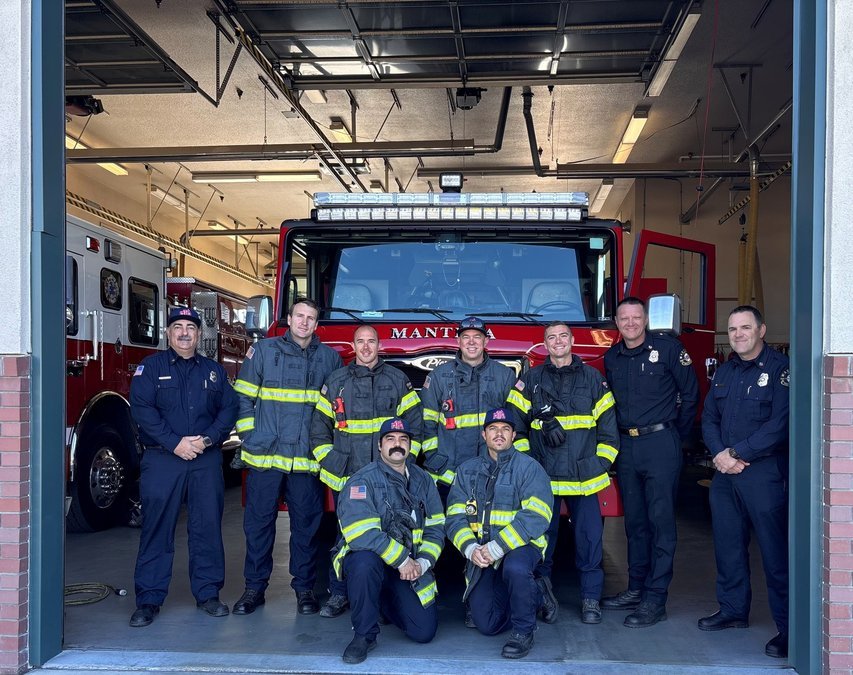
Manteca Fire could move toward enhanced emergency medical response thanks to passage of the Measure Q sales tax.
The City Council on Tuesday is being asked to use $95,208 in Measure Q receipts to secure a $952,072 federal grant to start a phase in of firefighters trained as paramedics able to take advanced life saving measures at the scene of medical emergencies.
The goal is to have earlier advanced intervention to improve cardiac and respiratory outcomes before an ambulance arrives on the scene.
As such, it would align Manteca with regional standards and strengthen the city’s emergency system reliability.
Having firefighters with advanced life support (ALS) training to perform paramedic tasks is expected to have a big impact in Manteca given 84.9 percent of all 9-1-1 calls to the fire department were medical in 2025.
Data shows:
*Survival rates for cardiac arrest increase from 10 to 30 percent with ALS fire-first response.
*California systems report a greater than 35 percent survival rate with ALS.
*Asthma/COPD patients who receive nebulized meds early show a 20 to 30 percent reduction in respiratory failure.
Manteca Fire medical calls have climbed from 8,664 in 2022-2023 to 9,226 in 2024-2025.
Among those 9,226 calls 910 were breathing problems, 1,004 cardiac and stroke, 1,720 fall and injury, 2,373 illness and other, 597 lift assist, 625, motor vehicle accident, 269 overdose and psychiatric, 1,252 seizure and in unconsciousness, and 476 lifts.
The additional ALS service would be done while partnering with Manteca District Ambulance to build a stronger system.
Manteca Fire would not transport patents. As such, taxpayers aren’t burdened with those costs nor would the city undermine the non-profit ambulance service that consistently matches and often exceeds private ambulance firms in terms of response and reliability.
Currently, 90 percent of fire agencies in California serving more than 100,000 residents provide ALS first response. Manteca is expected to surpass 100,000 residents within two years.
Should the council endorse a phased ALS implementation, accept the grant and approve the match, the fire command staff will present a final ALS plan in July of 2027.
A study would also be conducted on a first responder fee that is a cost recovery mechanism allowed under California law for emergency medical responses provided by fire departments.
The initial $1,047,280 effort that could start rolling Tuesday with approval of the match and accepting a federal grant would cover $171,400 for tuition and $875,000 in backfilling firefighters via overtime allowing the training to take place.
The plan calls for a two-person ALS vehicle to be operated during high call times by late 2027.
Apparatuses would have one paramedic each by 2030.
The plan is to train existing firefighters.
The initial equipment costs needs for the 2027-2028 budget for equipment comes to $262,000.
The cost to startup with paramedic on one apparatus is $110,000 to $262,000 with an ongoing cost of $47,000 to $104,000.
The start-up cost for paramedic services on all six engines is $460,000 to $777,000. The annual ongoing cost for six engines with ALS capability is $97,000 to $224,000 annually.
The City Council meets Tuesday at 6 p.m. at the Civic Center, 1001 W. Center St.
To contact Dennis Wyatt, email dwyatt@mantecabulletin.com