Railroads transform communities.
That is what happened in 1870 when Western Pacific Railroad built a line through a small cluster of farms in and around what is now modern-day downtown Manteca from Stockton to the Stanislaus River.
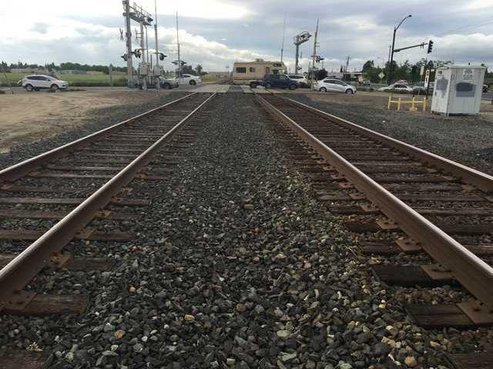
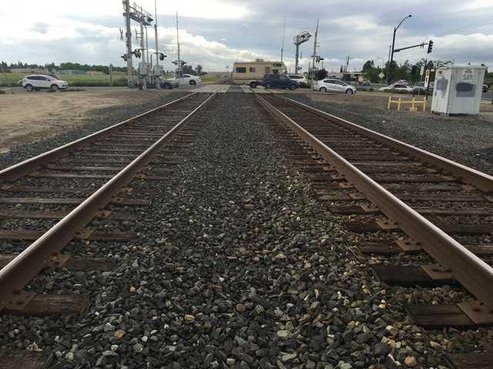
The line served as a precursor segment to what is now the Union Pacific Fresno line that currently handles between 30 and 40 trains a day.
Back then, the depot was a discarded boxcar sitting next to where Yosemite Avenue crosses the tracks today.
Those wanting to ride the train would flag it down.
That lone boxcar depot was the magnet that led to the formation of a trade center, if you will, where farm goods could be moved to market and people could secure quick travel to other communities to conduct business.
Manteca and it’s economy literally grew up around the boxcar depot on the railroad line.
Councilman Mike Morowit sees the railroad once again playing a more stepped up direct role in driving Manteca’s economy whether it is moving goods or people.
He sees the plans to ultimately double track the railroad from Lathrop to Merced to best accommodate future ACE commuter and freight train movements as a game changer for Manteca.
The initial double tracking segment between the Lathrop Wye and a point just south of the Manteca transit center is part of the effort to bring ACE service to downtown Manteca and farther south to Ceres.
The earliest that could happen is in the 2027 to 2028 timeframe.
The impacts of double tracking to allow more robust traffic and freight movements on Manteca includes:
*helping reduce the time trains often block some of the surface street crossings that number 15 on two separate UP lines.
*the ability to access an expanded ACE train network for commuters and others to reach San Jose/Silicon Valley or Sacramento. That would be expanded further with ultimately Valley Link service from Lathrop to Pleasanton to allow ACE transfers to the BART system all the way to San Francisco.
*attracting distribution centers and manufacturing concerns heavily relying on rail’s ability to move goods long distance at a lower cost than trucking alone either via boxcars and such or intermodal truck-train movements.
A hub for distribution
& producing goods
Morowit noted it is why private concerns are now working on establishing a railroad spur to serve land zoned for business park and industrial to the north of Manteca and south of French Camp Road.
Trains, according to the American Association of Railroads, moved 38 percent of all goods and shipments in 2023.
Manteca, where it is wedged between two intermodal facilities — Union Pacific on Roth Road and Santa Fe on Austin Road, is uniquely situated even within the Northern San Joaquin Valley that is turning into the distribution/support industry hub for the Bay Area just like the Inland Empire of San Bernardino and Riverside counties is for the Los Angeles Basin.
It also has quick access to the key West Coast freeway — Interstate 5 — and California’s Highway 99 freeway that runs the length of the world’s richest agricultural region that’s within the Central Valley.
Stockton Metro Airport is minutes away and the Port of Stockton is within 15 minutes.
Concerns that generate jobs to distribute and/or assembly products and goods have easy access not just to all forms of transportation but are able to access 18 million consumers within 100 miles between the Bay Area and Sacramento.
Making freight, commuter
rail movements quicker
Double tracking coupled with separating an at-grade crossing of Santa Fe and Union Pacific lines in Stockton will eliminate a major bottleneck for trains.
It is especially critical to make heavy rail commuting via ACE with connections to light rail/bus systems in employment hubs a time efficient alternative to driving.
Manteca, when all is said and done, will also have so have something no other community in the region has — residential areas with the closest access to two passenger commuter rail stations.
One is in the heart of Manteca on Moffat Boulevard in downtown.
The other is less than a mile to the west of where Manteca plans to eventually accommodate upwards of 2,500 to 3,000 more homes north of Lathrop Road.
The Lathrop Wye is where the ACE/Valley Link transfer station will eventually be built.
To contact Dennis Wyatt, email dwyatt@mantecabulletin.com