Jacob Naven believes neither growth or economic development should push aside the core values that Manteca holds dear.
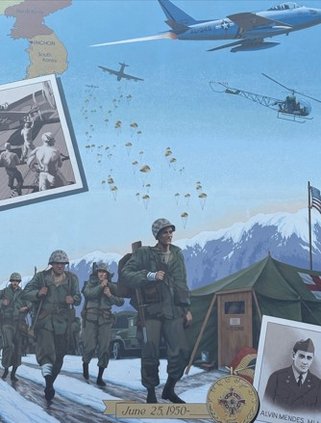
It is why, if elected mayor on Nov. 3, he promises to push for preservation protection for the four veterans murals gracing the east facing wall of the IOOF Hall (Manteca Bedquarters) that the city recently purchased for $1.2 million.
“They (the murals) represent a lot of sacrifices and are why we have Manteca and the freedoms we do,” said Naven, who is challenging incumbent Gary Singh.
Naven said he is reminded of that not just when he drives past them, but also when he joins fellow Sunrise Kiwanis members when they place American flags along Main Street and Yosemite Avenue in downtown 11 times a year as part of the Manteca Chamber of Commerce’s Flags Over Manteca endeavor.
Naven said the importance of the murals to many Manteca residents is reflected in a recent Facebook post by Amy Rothlin.
Rothlin’s post, accompanied by a photo of relatives in front of one of the murals, states “That’s my mom Laura Rothlin and her two brothers John and Frank Mendes standing in front of the memorial to their brother Corporal Alvin Mendes who was KIA/MIA in the Korean War.”
Alvin Mendes’ image and the fact he was KIA/MIA was incorporated in the Korean War mural.
The five murals also represent World War I, World War II, the Vietnam War, and the Global War on Terror.
The World War II mural contains likenesses of local residents who were among those 958 names those who served that was listed on a billboard on the Wall of Honor that dominated the same IOOF Hall wall during that war and several years afterwards.
Naven is against any effort to remove, or even move, the murals.
He argued not only are they the most prominent face of the 30-plus mural project the city inspired in its Vision 2020 Task Force report, but the City also helped pay for the cost connected with prepping the walls for murals to be done professionally.
“There is no other wall like it in Manteca,” Naven said. “It is where they belong and not tucked away (from a major street).”
Naven said he understands there was no guarantee when the Manteca Mural Society raised $125,000 to do the murals — including weekends when Vietnam veterans stood on the corner of Yosemite and Main with buckets to collect money to honor their fallen 19 comrades from Manteca — that they would stay in place forever.
But he said the fact the city now owns the building that they justified purchasing to assure that it would have maximum benefit to the community and downtown development going forward changes the dynamics.
Naven said that is especially true when the city also justified the $1.2 million purchase noting the building not only had historic significance for Manteca but the architecture was unique the community as well.
Naven is not the first to call for preserving important parts of Manteca’s history — and for want of better words — psyche as the city grows.
That distinction belongs to a previous City Council that had volunteers inventory significant landmarks for possible preservation at the instance of the Manteca Historical Society when it was led by the late Ken Hafer.
City’s general plan calls
for preservation efforts
Manteca — according to municipal policies adopted 23 years ago — is supposed to identify and protect the city’s historically and architecturally significant buildings.
Yet nothing has been done in terms of putting policies in place to protect historic and significant buildings as the current general plan states “shall” be done.
Those policies as stated include:
*The city shall set as a priority the protection and enhancement of Manteca’s historically and architecturally significant buildings.
*The city shall work with property owners seeking registration of historical structures as historical landmarks or listing on the Register of Historic Sites.
*The city shall prepare and adopt a Historical Preservation Ordinance.
The late Ken Hafer — considered by many to be the dean of Manteca history — worked with volunteers and the city to come up with an inventory of historically significant buildings and sites in Manteca.
The idea was they would at least be officially identified and possibly steps taken to protect some of them.
Nothing concrete came from that effort.
The general plan noted there are 95 cultural resources that span prehistoric and historic periods in the Manteca area that range from a Native American village site to historic period railroads, schools, buildings, and single family homes. T
The 95 sites are identified in the Central California Information Center files of the California Historical Resources Information System. They include schools such as Lincoln and Lindbergh, the City of Manteca municipal water tower, the former Tidewater Southern Railway, and East Union Cemetery.
There are also six buildings listed on the San Joaquin County Historic Property Data File Directory including the IOOF Hall — the oldest commercial building in Manteca that the city just bought.
IOOF is arguably
most significant
historical building
The two-story brick structure was built in 1911.
It is arguably one of the most — if not the most — significant historic building in Manteca. It is where the Manteca Board of Trade — the forerunner to the City of Manteca.
A cross between today’s city council and chamber of commerce, the board’s main goal was to promote the community that had not yet been incorporated. The American model of board of trades was based on a government form first employed in England in 1696 under King William III to handle the administration of unincorporated towns.
It was on the first floor where Bedquarters was located until a few months ago where early municipal decisions were made such as installing warning bells at the railroad crossings, establishing fire protection, promoting Manteca at both the State Fair in Sacramento and Panama-Pacific Exposition in San Francisco in 1914, and the launching of the first Boy Scout Troop.
The board also accepted the donation of land for the first Manteca park — Baccilieri Park — that is just south of downtown. The board worked tirelessly to promote farming with the development of the South San Joaquin Irrigation District system. They also rejected allow any more sign boards around the city, complaining that they were becoming an eye-sore.
It is also where the decision was made to seek an election to incorporate Manteca as a city. The town by 1917 had grown from 300 when the board was first organized in 1909 to just over 1,000 residents.
Despite the historic significance of the IOOF building, there is not even a plaque noting its importance or an official status granted it as a historic site by the city.
To contact Dennis Wyatt, email dwyatt@mantecabulletin.com