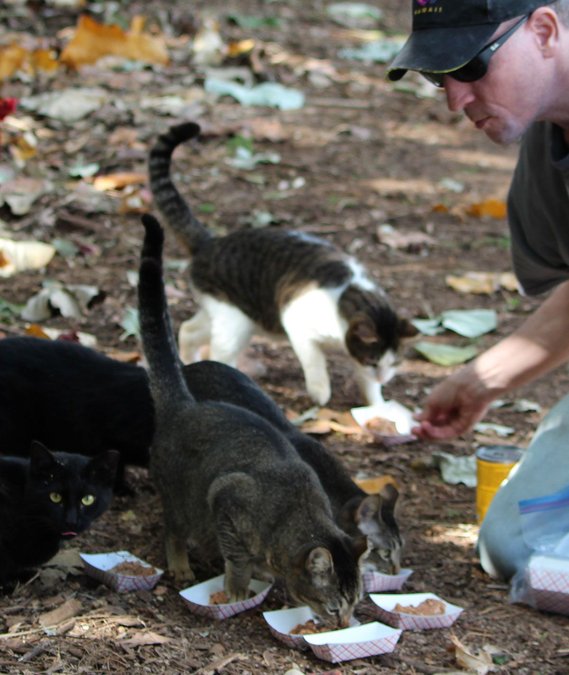
Feeding feral cats in Ripon parks — especially at Marvis Stouffer Park and along the Stanislaus River — indirectly increases the threat to wildlife including the endangered riparian rabbit.
That point was made Tuesday before the Ripon City Council unanimously adopted an ordinance amendment that will prohibit anyone from feeding feral cats on public property except for an animal control officer conducting a trap program.
The ban won’t go into effect until, after a second reading at the September council meeting.
Police Chief Daniel Sauer noted such a municipal ban will allow city staff and/or police to issue a warning in a bid to educate people not to feed the feral cats.
The ban could have some bite, though, as the city would have the ability to issue a $100 citation if people don’t comply.
The January 1997 floods were literally and figuratively a watershed event for the survival of the rabbit that resembles the desert cottontail but is smaller with a darker, grassy brown coat minus a black tip on the ear as well as having a smaller and a less conspicuous tail.
Prior to the flood 29 years ago that inundated Caswell State Park as well as 70 square miles between Manteca and Tracy, the state park unit along the Stanislaus River was home to an estimated 200 to 300 brush rabbits. It was the largest known concentration in the wild of the endangered species.
A year after the flood, only one of the rabbits that as an adult reach 11 to 14 in length and weigh between 1 and 1.8 pounds was spotted at Caswell State Park.
There has been a concerted effort to bring back the riparian rabbit population that exists nowhere else but along the Lower Stanislaus River and lower San Joaquin River before it reaches the Delta.
Municipal staff has observed a growing number of abandoned cats not just in larger parks such as Stouffer Park but also at neighborhood parks.
It was noted the growing abandoned cat population is “often sustained by residents feeding them in public places.”
It was also pointed out that if “left unvaccinated and unsterilized, these stray populations pose disease risks to other domestic animals” as well
The ordinance makes it unlawful for any person to feed, cause to fed, offer food to any animal, or to scatter food, seed, or other forms of matter edible to animals on any public property including but not limited to streets or street right of ways, public buildings, sidewalks or driveways, parks, and public facilities.
To contact Dennis Wyatt, email dwyatt@mantecabulletin.com