The 1981 booklet is simply titled “Symbolism… as displayed and used at St. Paul’s.”
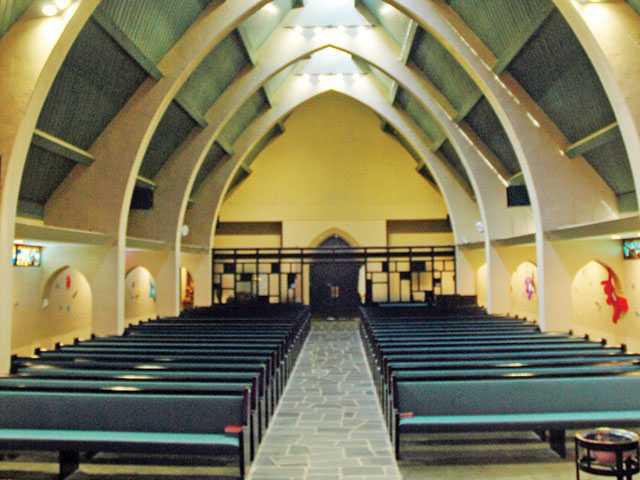
That’s St. Paul’s United Methodist Church on the corner of Powers Avenue and East North Street in Manteca.
The 12-page, hand-illustrated, typewritten, and copy machine-printed brochure may appear to be a simple publication but it is a printed repository of the deep symbolism and meaning of every piece that is seen inside and outside the church.
“Symbolism is the sign language of our faith. A symbol is a sign. It must be representative of something, but not merely a representation or picture. A symbol is used to convey an idea or a belief,” so reads the preface to the list of symbols explained in the brochure.
Below are samples of those symbols and their meanings.
u The building. When you come in to the church from the front entrance, you’ll notice that the floor plan is in the form of the cross. The entrance is at the foot of the cross, a space designated as the narthex. The corner to the left is the baptistery, which carries out the “traditional idea that the baptismal rite is the first requisite to entry into the church.”
Where the building materials came from: The church was built using basalt blocks, with the roof made of Bermuda tile. The slate for the floor was quarried in Vermont and shipped to Manteca via the Panama Canal. The cornerstone is Swedish granite, and the stained glass used in the windows is antique glass imported from Europe. All the tiles are handmade.
• The spire rising above the structure topped by a cross was fabricated of porcelainized metal; the cross of stainless steel painted orange to signify the “Orangemen, an association of English Protestants.”
• The ship sculpture in front of the building represents the church, and depicts Christ at the bow, symbolizing that Christ is the head of the church. The fish in the sculpture is a traditional symbol for the Christian. The sculptor was Pierre Menager from Santa Fe, New Mexico.
• The Old Testament Window. The stained glass windows running the full length of the nave on each side highlights some of the central stories in the Bible. Principal themes are the creation, Noah and the great flood, Abraham as the father of the Hebrews, and the stories of Joseph, Moses, Joshua, Ruth, and the prophets.
• The New Testament Window. This frieze begins with the story of God sending his son to save the world. Other scenes portrayed in stained glass are the Annunciation, the Nativity, Christ’s baptism, Jesus teaching, preaching and healing, and scenes of Christ’s transfiguration, crucifixion, resurrection, the descent of the Holy Spirit upon the apostles in the Upper Room, and Peter and Paul, among other scenes.
• The Chancel inscriptions. Above the chancel is an inscription of Psalm 150, which is adorned with the following symbols: butterfly for resurrection, crown for the kingship of Christ, sunburst for God the Father, fish for individual Christians, an open pomegranate signifying the resurrection, and the three rings symbolizing the Holy Trinity.
• The Te Deum Window. The Te Deum window is the series of three stained glass lancets above the altar. Directly over the altar is the lancet showing the figure of Christ, drawn from a 15th-century Italian painting of Jesus as Christ the King. The lancet windows flanking Christ are depictions of the saints of the church from the first century to modern times, and are shown “paying obeisance to Christ.” Among the saints depicted are Polycarp, Perpetua, Ambrose, St. Augustine, Savonarola, Boniface, and John Wesley, the founder of Methodism.
The stained-glass windows were “fashioned” by John Wallace of the Wallace-Wiley Studio in Pasadena.


