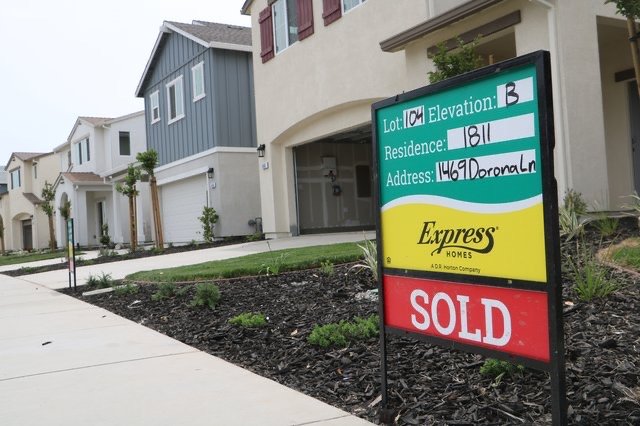
Manteca is toying with implementing an affordable housing fee.
Adding a fee to the cost of a new home to fund affordable housing will accomplish one of two things.
*It will make the buying of an at-market home less affordable.
*It will accomplish next to nothing and it will take years for anything to happen.
A study done in 2022 at the city’s expense indicated Manteca could justify a maximum $31,106 fee on the base price of a 1,845 square foot home.
Given the study is three years old, the city will feel a burning need to write another check to update it.
Here’s a suggestion: The City needs to refrain from the urge to do so.
Instead, they need to come up with a program that could actually work and then establish a fee.
The good news is they don’t have to look far for a program that actually works to create more affordable at-market housing.
It’s the type of housing that can actually be built without being heavily subsidized and taking years to build.
The answer can be found in Mountain House.
From the first foundation poured 22 years, it has been a requirement that at least one of every 10th home built in Mountain House have an auxiliary dwelling unit.
Almost all are under the same roof as the “main” house.
They are completely separated from the rest of the house.
They have their own bedroom suite, living area, bathroom, and kitchen.
The initial appeal to those that opted for the separate ADU under the same roof was for parents or even older adult children.
But over the years they have ended up renting such ADUs to non-relatives.
It is added income that they can put to good use, including paying down the mortgage.
A 22-year track record clearly shows there is a market.
It was a market that buyers created when they were offered floorplans with the casita options.
Builders didn’t have to reduce the selling price to find buyers.
There simply was another housing product that was being offered for buyers to consider.
Yes, it could be an up sell.
Or it could have been an option to still spend the same amount of money but do so by having less square footage for the main house.
The bottom line is it worked without being subsidized by affordable housing fees slapped on the issuance of building permits for new homes.
It is also clear the most effective way to increase housing stock in California is via ADUs.
Not only can they be built as part of new home but they can be added in existing and older neighborhoods.
It is why Manteca needs to jumpstart the building of ADUs in existing neighborhoods.
And it is why Manteca’s leaders need to offer a true carrot and stick option that, if the stick is the preferred option for a developer, then the stick needs to be effective and not grow moss.
The city’s affordable housing plan needs to be built around the goal of adding as many ADUS as possible.
Here’s how it could work.
Manteca needs to give developers an option.
They can be required to either build at least a tenth of their homes with ADUs or pay a $5,000 affordable housing fee on every home they build.
The $5,000 fee would go into a revolving loan account to help fund ADU construction in existing neighborhoods.
As such, it would set the stage for the segment of the community most likely to add ADUs that is also the least likely to qualify for a traditional mortgage — older, retired homeowners.
Taking advantage of such a revolving loan would also mean those seniors would have a new income stream to add financial security in their golden years.
They would have two options.
One would be downsizing to the ADU they could build and rent out the main house.
The other would be to rent out the ADU.
Either which way, it is a win-win situation.
The city gets more needed housing that costs less to rent.
And the building and renting of the ADU improves the financial quality of life of older homeowners.
The improvement in the financial outlook of such homeowners can be substantial especially if they opt to move into the ADU that is built.
The money that is paid back to the city’s ADU revolving fund can then be used to finance more ADUs.
Why, you might say, doesn’t the city mandate housing fees and build more subsidized housing.
Three words: Cottage Village Apartments.
The 48-unit senior citizen complex on Cottage Avenue is nestled against the southwest corner of the Highway 99 overpass.
Do not misunderstand. The complex is solid.
The problem is it took close to seven years to get built.
And it required the agency the city was working with to secure funding from various sources that, by the time it was lined up, construction inflation required finding more money.
There is also built-in advantage with ADUs. They do not require major infrastructure investment or the purchase of land.
They are typically close to schools and often neighborhood shopping.
They can also inject new life into old neighborhoods.
Manteca could tear the page out of the playbook that has failed California miserably and has failed to make a dent in the housing crisis.
And by imposing a fee that requires years of accumulating enough money to do anything of consequence, they will effectively make housing less affordable.
If Mountain House is any indication based on current home building pace in Manteca, the City could add 100 more affordable at-market living units a year without collecting a dime in fees.
And if of the 1,000 plus homes being built now annually, developers opted to pay a fee instead, it would generate $2.5 million or enough to issue 15 loans of $155,000 to build ADUs.
Couple that with the 50 ADUs the builders or the 500 homes that opt not to pay fee, and that’s 65 ADUs.
And that is 65 affordable housing units that are not being built now on an annual basis.
This column is the opinion of editor, Dennis Wyatt, and does not necessarily represent the opinions of The Bulletin or 209 Multimedia. He can be reached at dwyatt@mantecabulletin.com