The Criminal Justice classes in Manteca Unified School District brought in a Sheriff’s evidence technician and a deputy who works primarily for the Coroner’s Office.
The 60 students were presented with the inside story of what happens with a body in a criminal investigation following a murder or suicide. High school instructor Joe Waller said his students were intrigued by the fact that someone has to do this type of work.
He added that many of them have shown an interest in investigative work where they won’t have to make actual contact with criminals in the field.
“One guy had set his house on fire committing suicide, because he was depressed and wanted his family to the get the insurance money,” he recalled.
Coroner’s Deputy Sandra Mendez also talked about her role in the notification of the families of the deceased and the further investigation of suspicious deaths.
Mendez related how long a body will remain at the Coroner’s office before it is turned over to the family or have it cremated if it is that of a homeless person.
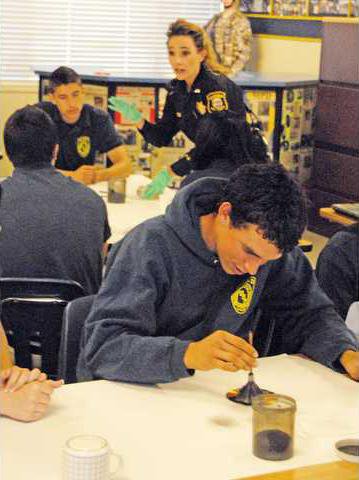
Sheriff’s evidence technician Julie Book held a fingerprinting workshop for all the classes last week. She pointed out the three different types of prints – arches, loops and whorls – found during her investigations of individuals as she walked students through a crime scene.
She explained that arches make up only about five percent of finger print types. Loops account for some 70 percent of the total print patterns found and 25 to 30 percent are whorls.
The technician outlined the procedure of locating the blood splatters and securing the scene with yellow police tape to keep members of the public from contaminating the evidence.
Book also explained the taking of fingerprints from a body that had started to decompose. The person’s finger tips are ballooned with an injection of air to reform the finger pad tissue and its identifying pattern.
The deputy noted how her department works with the California State Crime Lab in Ripon. She also described the processes of an autopsy on a deceased victim. Often in the case of a violent death, such as a shooting, the brain is removed and set to the side as are other organs in searching for the exit wounds in a homicide.
Female students make up about one third of the Criminal Justice classes within the school district, Waller said. Law enforcement speakers this year came from the Manteca Police Department, the California Highway Patrol, and the Sheriff’s Department. The Stockton Police Department services Weston Ranch High School classes.
Among Waller’s former students, who have gone into law enforcement during his 14 years in the classroom, is Manteca Police patrolman Ian Osborn. There are several of his students who are now working for the San Joaquin County Sheriff’s Department, he said.
Many students have already signed up for the next round of Criminal Justice classes in the Fall semester.
Sheriffs technician offers fingerprint workshop for high school students