Aaron Jeffery has heard it all.
Manteca isn’t fixing its streets.
Road conditions are deplorable.
Streets are creating car alignment issues.
And the one that contradicts it all — the work the city is doing to improve roads is a royal pain.
Jeffery is Manteca’s streets guy.
His official title is Assistant Director of Streets & Compliance.
It’s his job to make sure issues such as potholes, excessive pavement cracks, and other road hazards don’t linger.
There are 400 plus linear miles of streets the city’s 19-member crew — 15 full-time and 4 part-time — maintain in addition to sidewalks and more.
Keep in mind, the city had just an 8-man street crew from 2008 to 2016 after it was halved in budget cutbacks 16 years ago due to the Great Recession when the city tailored spending to declining revenues instead of seeking a tax increase.
Back in 2008 there was just over 300 linear road miles to maintain in Manteca.
Since the chaos that once ruled the city’s bureaucratic leadership was eliminated and elected city leaders starting back in 2000 had the political will to create more muscular revenue streams that included proposing and campaigning for the Measure Q temporary sales tax, the city has restored its street division to per-2008 levels and then some.
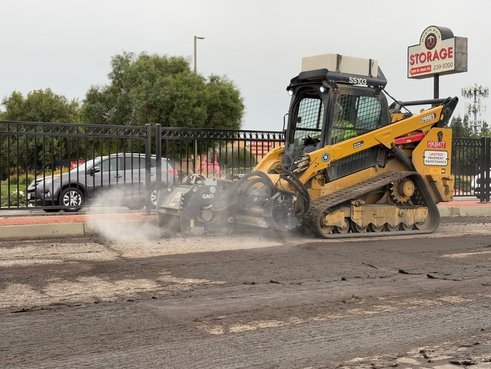
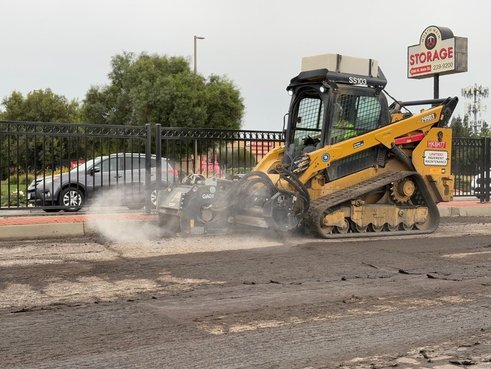
It also has picked up the pace of street work project endeavors including more severe needed road upgrades by tackling smaller segments with the in-house crew over the course of several years as they have done on Spreckels Avenue.
The number of road projects of consequence that have been completed or underway now stand at the 25 mark since 2020.
That includes everything from work on major streets such as Airport Way, Lathrop Road, Main Street, and Louise Avenue as well as nine large-scale neighborhood reconstruction or maintenance projects to preliminary work for new diverging diamond interchanges along the 120 Bypass at Main Street and Airport Way.
In the past year, projects have involved 25,000 linear feet of pavement using 6,000 tons of asphalt spread 12 feet wide and 2 inches deep.
City pavement condition
in place is now at 70 percent
Jurisdictions rate street pavement by pavement conditions to determine where to direct limited resources and to determine the type of work needed from micro-surfacing to complete reconstruction.
The index is based on a 0 to 100 scale with 0 basically being a dirt road to 100 reflecting new pavement.
Manteca’s current overall pavement condition index is 70, what Jefferey said may be viewed as a C-minus.
That said, he has worked with nearby jurisdictions where the PCI is much lower.
In order to bring all streets in Manteca to a 100 rating, it would cost $138 million.
To put that in perspective, Manteca spends $87 million a year to fund all general fund services including police, fire, street maintenance, parks, as well as recreation and other services.
The city’s goal is maximizing pavement life by spending available money in the most cost effective way.
It is why in neighborhoods such as Del Webb where the streets are newer are given attention.
The work being done — micro-surfacing — is designed to stretch the life of the asphalt that has a rated lifetime of 25 years.
The process essentially rejuvenates the asphalt.
By aggressively refreshing somewhat newer streets, the city can keep extending the life and postpone incurring much large pavement repair needs.
At the same time the city does such work, they have also undertaken projects to bring older streets with pavement issues up to like new standards.
Older streets were built
to different standards
Manteca faces the same problem as other growing California cities.
Not only were older streets built for less traffic and minimal truck traffic, but often subdivision streets prior to the 1980s were often not required to have pavement applied over a base.
That is what led to the widespread cracks in Mayors Park and Springtime Estates — two neighborhoods where the city over the past four years invested in costly pavement replacement work.
The other issue is that many of Manteca’s arterials — such as Lathrop Road, Louise Avenue, Airport Way, and Austin Road were built as small two-lane country roads decades ago.
Projects are also delayed by issues outside of the city’s control.
Manteca, as an example, has a project to widen Airport Way to six lanes between Daniels Street and Yosemite Avenue.
The city is tapping into just over $6 million that is Manteca’s share of a state-mandated utility undergrounding program that has to be committed to a project or the city loses it.
The project the city selected was Airport Way given the need to set back power poles to widen the street.
They will be undergrounded instead to save taxpayers the millions it would take to simply move them back.
The earliest PG&E has indicated it can do the undergrounding work is 2033.
To contact Dennis Wyatt, email dwyatt@mantecabulletin.com