Looking for a low-key place to explore the San Joaquin Valley in its natural state complete with hiking trails — most that are suitable for mountain bikes — as well as picnic areas?
The Dos Rios State Park is a 25 minute backroads drive from Manteca that also gives you a chance to appreciate valley farming along the way.
The 2,100 acre state park opened in 2024 .
It was once private farmland that has been restored to its natural state at the confluence of the Tuolumne and San Joaquin rivers.
It allows visitors to step back in time as they meander through a restored floodplain forest to explore the reconnection of water, wildlife, conservation and ranch life.
Dos Rios is home to various threatened and endangered species, including the valley elderberry longhorn beetle and the riparian brush rabbit.
It also supports the life cycles of Central Valley Chinook salmon and steelhead trout, and is a haven for birds on the Pacific Flyway.
The park is open Friday through Sunday from 7 a.m. to 5 p.m.
It can be reached from Manteca by taking Airport Way across the San Joaquin River.
Once you cross the bridge turn left onto Kasson Rad where the Jimmy’s One Stop is located.
Head south on Kasson Road past a historical marker on the left where San Joaquin City once stood in the 1870s-1880s as the farthest south shipping point on the San Joaquin River to move the wheat crop to market.
You will eventually come to a traffic signal at Highway 132.
Turn left heading toward Modesto.
You will again cross the San Joaquin River.
At the first crossroads, you will turn south onto Paradise Road (A left turn at the intersection would put you on North Gates Road instead).
Travel on Paradise Road until you reach the T-intersection with Shiloh Road and turn right.
The entrance to Dos Rios State Park will be on the right.
The entrance is not fancy. It is marked by a white rail fence and has a wrought iron gate. Signage is minimal.
Steel transmission poles run alongside the start of the entrance road.
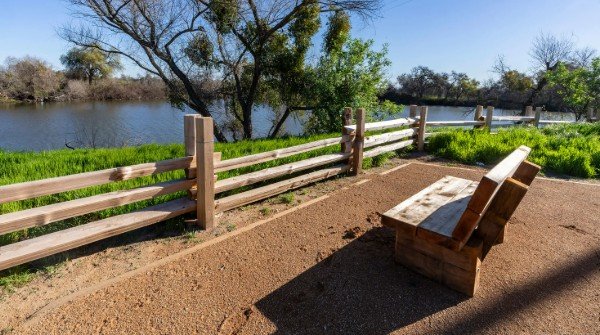
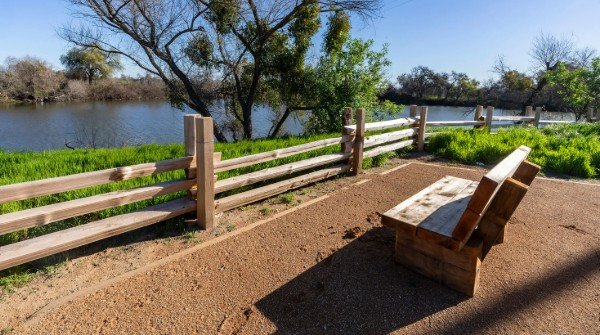
Once you reach the Dos Rios base camp you can take a quarter-mile pathway beside the edge of the pond.
You can have a picnic and barbecue with friends and family in an ADA accessible ramada overlooking the pond and view birds.
Anglers may fish in certain areas of the Tuolumne and San Joaquin rivers for largemouth and smallmouth bass, catfish, bullhead, bluegill and other sunfish, crappie, pikeminnow and trout.
All anglers 16 and older must have a valid California fishing license and keep it on their person for inspection by either California Department of Fish and Wildlife officers or State Park peace officers.
15 plus miles of trails
There are currently more than 15 miles of hiking and bicycle trails at Dos Rios.
*On the San Joaquin River Loop Trail (2.2 miles), visitors walk along the banks of the San Joaquin River for majestic views of ancient oak trees or swimming at Oak Beach.
*The Upper Tuolumne River (2.25 miles) and the Lower Tuolumne River (1.5 miles) trails connect with the existing Pond Loop Trail and give visitors a scenic walk along the clear waters of the Tuolumne River while providing access to Secret Beach for fishing and Willow Beach for swimming. Please note: Lifeguards may not be on duty, and swimming is at one’s own risk.
*Quail Trail (3.6 miles out-and-back) brings visitors through the heart of the forest floodplain with open views of the Diablo Mountains. And you just might spot a rabbit or two that are known to make their homes in this area.
*Beaver Bend Trail (1.4 miles one way) connects the Confluence Trail with the Lower Tuolumne River Loop Trail. This lush, shaded trail features glimpses into the riparian habitat where you can look for evidence of the beavers’ hard work overnight.
No services are provided on the trails, so visitors are encouraged to bring all necessary food and water and carry out their waste for disposal in base camp (the day-use area).
Dogs are welcome in base camp and on the Pond Loop and Confluence trails only.
Dogs must be on a leash no longer than 6 feet long at all times. Bring water for your dog and pick up and pack out any waste as no trash services are provided on the trails.
Campfires are not permitted.
Visitors may use the provided grills on a first-come, first-served basis.
All natural and cultural features are protected by law and should not be disturbed. That means no collecting — period.
While the low, easy summer flow of the Tuolumne and San Joaquin Rivers are inviting, swimmers should watch out for deep holes.
No lifeguards are on duty.
Use caution in the cold river water; water levels change rapidly. Visitors should always wear life jackets while in or near the river.
River Partners and the Yosemite Rivers Alliance led efforts to permanently protect Dos Rios by purchasing the property in 2012.
To date, an alliance of dedicated public, private, and nonprofit partners planted more than 350,000 native trees and vegetation along nearly eight miles of the San Joaquin and Tuolumne rivers that converge at the heart of Dos Rios.
About 1,600 acres have been restored so far, and restoration work is ongoing on another 500 acres on an adjacent former farm.
River Partners has historically used existing irrigation infrastructure on the former farmland to help young vegetation endure hot dry summers as the vegetation was initially established.
Bunny ramps and mounds have also been developed for endangered species, like the riparian brush rabbit, to escape to higher ground during periods of flooding.
Thanks to these various restoration efforts, Dos Rios now provides large-scale habitat for endangered species such as the riparian brush rabbit, riparian woodrat, Swainson’s hawk, Central Valley Chinook salmon, steelhead trout, least Bell’s vireo, yellow warbler, sandhill crane, and an entire suite of neo-tropical migratory songbirds.