Before Ripon was known as Ripon in 1874, it was called either Stanislaus Station or Stanislaus City.
Stanislaus was a name bestowed by settlers once a community started growing where a ferry crossing had been established on the Stanislaus River.
Why this matters today is simple.
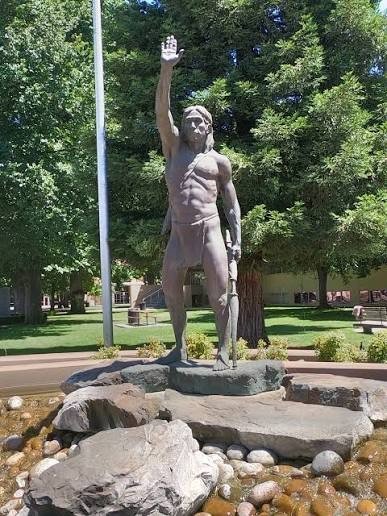
Ripon High, as of 16 days ago, can no longer legally use Indians as its high school mascot.
It is the result of the California Racial Mascots Act of 2024 passed by the California Legislature and signed into law by Gov. Gavin Newson.
The state mandate stipulates no public school in the Golden State that isn’t under the control of a recognized tribal organization is allowed to have its school or mascot use “any derogatory Native American term.”
Without a side trip into why that is considered derogatory by those with indigenous roots, don’t forget it was a moniker hung on an entire continent of people by Christoper Columbus in 1492 when he erroneously thought he had found a short cut to India, the name at the time Europeans gave to what is today all of South and East Asia where modern India can be found.
Ripon High back roughly 110 or so years ago adopted Indians as the mascot for its sports teams.
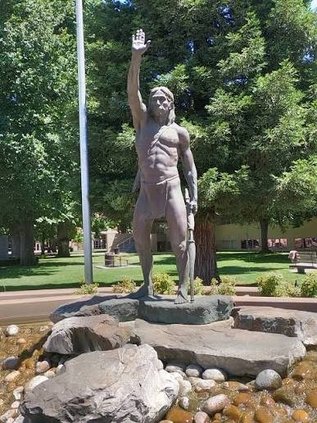
Historic accounts reference they were inspired to do so by a Yokut chief named Estanislao.
Estanislao was as a defender of his people, intelligent, resourceful, and willing to sacrifice it all for a just and righteous case despite exceedingly overwhelming odds.
One of his greatest feats in trying to defend the peaceful ways of his people who were the first true “settlers” of the San Joaquin Valley long before the Spanish government and Catholic Church thought to “civilize them” in order to colonize what is today California occurred just west of Ripon and south of Manteca near where the San Joaquin and Stanislaus rivers converge.
Arguably, Chief Estanislao is the most famous Yokut in terms of how members of various tribes are depicted in history.
He was born in 1798 along the banks of the Rio de Laquisimes (now known as the Stanislaus River) with the Yokut name Cucunuchi.
The river at the time carried a name conferred onto it by the Miwok.
Records at the Mission San Jose indicated mission padres visited the area near where Ripon is today in 1821. They convinced Cucunuchi to travel to the mission for a formal Christian education.
It was at the Mission San Jose that he was baptized “Estanislao” (Spanish for Stanislaus that is a Latin word for someone who achieves glory or fame) after his arrival at Mission San José.
In the 1876 publication “History of California”, Juan Bautista Alvarado noted “Estanislao was able to read and write and stood out among the leaders of other Central California Indian tribes”.
The young Estanislao didn’t like what the invaders were doing to his people so he created a resistance and encouraged others to flee back to the Central Valley.
Estanislao left the mission in 1827 leading 400 followers.
The group raided missions in San Jose, Santa Clara, and Santa Cruz.
They also raided Mexican settlements along the present day Stanislaus River.
This didn’t set too well with the Spanish since the resistance included returning the favor of disrupting ways of life by stealing cattle, guns, and horses from missions and ranches.
Estanislao taught those who joined him battle techniques he had learned from Spanish and Mexican soldiers.
The techniques — including trenches, palisades, and an early form of guerilla warfare — were essential to initial success on the battlefield. His raids were characterized as sudden, usually involving a trap, and ending with no loss of life, and he would sometimes use his sword to carve his initial, authenticating his handiwork.
Estanislao and others ended up near present-day Ripon where he named the river they found there.
While Estanislao acted out of concern that the Yokuts and others were being exploited, the Spanish believed they had to be taught a lesson. So, in 1829 some 40 men departed the Presidio at San Francisco to engage Estanislao and his men.
Even with a swivel gun mounted on a boat, the Spanish were defeated. Two months later General Mariano Vallejo returned with not just reinforcements’ but the willingness to burn the Yokuts out.
As a result, the soldiers killed Yokuts as they fled to the water to get away from the flames.
Estanislao was among the few that escaped.
Later Estanislao “repented”, was forgiven by mission priests in 1829, and became a staunch friend of Captain Charles Weber of Stockton.
Estanislao returned to the Mission San Jose on August 24, 1834. He prospered there while teaching others the Yokut language and culture.
Ripon High is in the process of asking permission of locally recognized federal tribes to again be able to use Indians as a mascot.