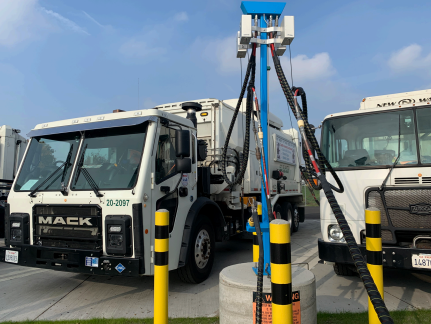
Garbage, or at least it’s collection, has come a long way in the last 68 years.
Just ask John Harris.
He’s a former 20-year Manteca City Council member that also served 12 years on the Manteca Unified School District Board.
Harris worked 32 years as a probation officer with San Joaquin County.
Before all that, his first foray into government service was dealing with garbage — literally.
It started within days of graduating from Manteca High in 1958.
He spent five summers as one of the City of Manteca’s summer laborers going into people’s backyards, hoisting the old 32-gallon metal garbage cans often weighing in excess of 50 pounds, and carrying them to the garbage truck where he then unceremoniously tossed the contents into the back hopper.
Harris also worked in street maintenance and parks.
That was back when there was no solid waste division with 48 employees.
Ray Okerson not only oversaw a seven-man full-time crew that handled all of the city’s maintenance needs but he did manual labor as well.
That was back when Manteca had 8,000 residents, a population roughly half the size of Ripon today.
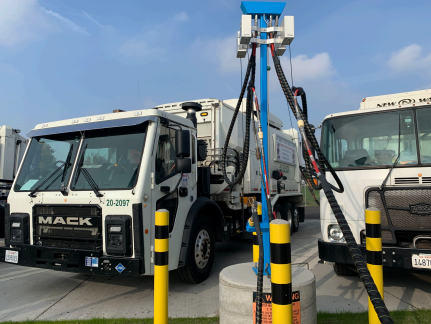
Manteca solid waste truck drivers today use “joy sticks” to control mechanical arms that hoist 96-gallon carts and dumps the content into the back of the collection truck.
Technology today allows the city to service 5,800 homes a day, not just with one truck but three.
Residential garbage is no longer a miss-mash of trash that was — in some jurisdictions back in 1958 was still being burned in a pit — or landfilled.
And there is a lot of garbage.
Manteca’s 98,000 residents are on pace to generate 57,850 tons of garbage that will be land filled.
That is in addition to 8,000 tons of recyclables being diverted for reuse and 11,000 tons of organic green waste destined to be converted into compost.
Our interactions with solid waste workers have changed.
Instead of being serenaded with rumbling diesel trucks and the clanging of metal, trucks are much quieter and we’re not just talking the whirl of the electric version.
The wastewater that the city’s 29,000 households send daily to the treatment plant where methane gas is captured and converted into a clean-burning fuel now powers trucks that collect our solid waste.
The compressed natural gas powered trucks are not only significantly quieter than diesel trucks but air pollution has been significantly slashed.
People have a tendency to take basic needs such as water, sewer, and solid waste collection the city provides for granted.
They also grumble about the cost.
And they can get irked when something goes wrong — such as a piece of cardboard ending up on the ground — during one of the 87,000 times in a given week the city tips a 96-gallon cart.
Given how rare such an occurrence is, it’s a pretty petty complaint.
To be clear, if people do simple tasks like make sure carts are loaded so the lids are flat, it wouldn’t be an issue.
The city on top of collecting trash everyday has been working to educate those “offenders” to comply with the rules. They use a carrot approach several times over before restoring to a stick.
What we toss — and the volume — has changed drastically since 1958.
Back then, many households in the Central Valley still had burn barrels they loaded with paper waste, including cardboard, and burned.
It is where a lot of yard debris — dried lawn clippings and leaves — were also burned.
Single use drink containers — first of tin, then aluminum, glass, and plastic — weren’t the rage. It was reusable glass bottles you returned to the grocery store to get your deposit back.
There was cardboard and packaging to get rid of but not to the degree it is today with 20 percent of what we consume being placed on our doorsteps.
And it is not brought by grocery store delivery boys carrying your order in repurposed boxes that were used to deliver canned goods and such to the store.
Instead, it is by delivery people bringing boxes and packages jammed with more packaging materials than goods.
Clearly the nation as a whole — and not just Manteca — has to do a better job recycling and being less wasteful.
We squawk that government isn’t efficient.
You try finding a better way to collect and dispose of trash from 29,000 plus households.
We whine Manteca isn’t innovative.
You can count on one hand the number of California cities that aren’t burning methane gas — the big Scrooge of greenhouse gas emissions — into the atmosphere and instead are harnessing to power low-emission trucks used to collect solids waste.
We grumble about the monthly cost of $58.72.
You forget the bottom line of that expenditure is we don’t have garbage piling up in neighborhoods helping bolster the rodent and insect population as well as creating a stink.
Government doesn’t work?
In the case of solid waste, that’s garbage.