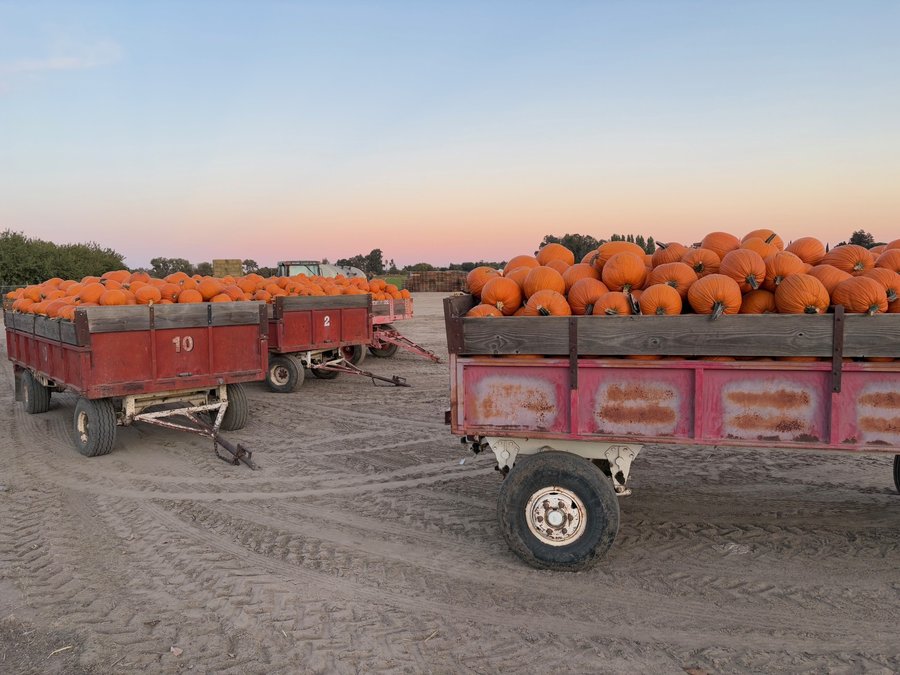
.The frost has yet to appear on the pumpkins although the Northern San Joaquin Valley on Monday saw its first significant rain of the weather year that started Oct. 1.
While the rain interrupted the harvest of later almond varieties until the ground dries, it was a good starting point for the new water season given some weather models are suggesting the Central Sierra and the Northern San Joaquin Valley could be experiencing a drier than normal winter.
The United States Department of Agriculture drought has indicated the entire Central Sierra that Northern San Joaquin Valley irrigation districts — and by extension a number of cities such as Manteca, Lathrop, and Tracy — rely on is experiencing drier than normal conditions.
That said, the South San Joaquin Irrigation District appears fairly well positioned for water supplies over the next 12 months.
The Bureau of Reclamation’s New Melones Reservoir — the linchpin on water management on the Stanislaus River watershed that Manteca water users rely on when they turn on a faucet — had 1,316,344 acre feet of its 1.6 million design capacity filled as of Sunday.
That’s 64 percent of overall capacity but more importantly it is 123 percent of the average for Oct. 12.
The outflow is 1,046 cubic feet per second — one CFS represents the volume of water that would pass a specific point in a second — as opposed to an inflow of 1,109 CFS.
Sixty miles downstream just past confluence of the San Joaquin River where the Stanislaus joins water from the Merced and Tuolumne rivers 10 miles south of Manteca , the flow was at 737 CFS.
The Tri-Dam Project reservoirs above New Melones SSJID operates in partnership with the Oakdale Irrigation District, all were at below average capacity on Sunday.
That includes Donnells at 26 percent, Beadsley at 58 percent, and Tulloch at 89 percent.
The current storm was expected to drop two to three feet above Donnells Reservoir located at an elevation of 4,917 feet.
To contact Dennis Wyatt, email dwyatt@mantecabulletin.com