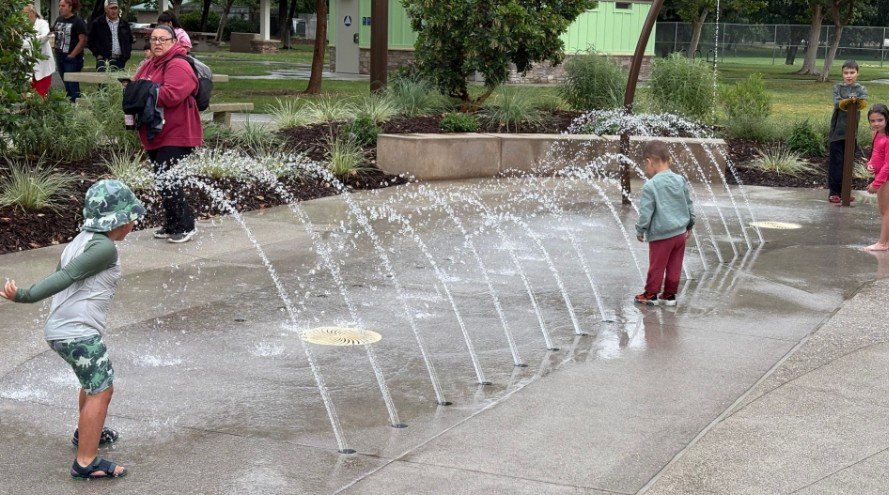
It was 75 degrees in San Francisco on Monday while Manteca-Ripon-Lathrop was basking in 106 degree heat.
No wonder the quip, “the coldest winter I ever spent was a summer in San Francisco” was coined.
It probably was from somebody in the late 19th century who spent the summer mining in the Sierra foothills or farming in the Central Valley and has to take a trip in July or August to the City by the Bay.
Manteca-Ripon-Lathrop is in the middle of what might be considered a hot spell by some standards.
And when it’s over, the likelihood the area will have experienced a dozen or so days over 100 degrees in a 20-day stretch is relatively strong.
But live in the valley long enough and what bugs you the most are the late evenings and the wee hours of the morning when the overnight low “plunges” to 75 degrees.
That’s when you miss what everyone takes for granted, the Delta Breeze.
It is part of the same marine layer of cool air coming off of the Pacific Ocean that can give someone visiting San Francisco wearing a T-shirt on a mid-August day hypothermia.
It is the same reason why air conditioning is far from universal in East Bay spots such as Walnut Creek and Concord where that breeze, when it is at its peak season from June to September, heading toward the Carquinez Strait can drop overnight temperatures 20 to 30 degrees from the daytime high.
Low spots in the Coastal Range relatively near the Delta such as the Altamont Pass keep areas such as South San Joaquin County cooler overnight than the rest of the Central Valley most of the summer.
Monday’s 106 degree high in Manteca was followed overnight by a low of 64 degrees in Manteca.
It is almost four degrees cooler in Manteca overnight than heading 52 miles south to Merced.
While Manteca is enjoying overnight lows in the 63 to 66 degree range this week, Merced is hovering between 67 and 69 as its bottom daily temperature.
Go another 50 miles south to Fresno, and the lows are expected to be between 71 and 77 degrees.
And if you won’t to work up a real overnight sweat, head 207 miles south to Bakersfield where the overnight low range is expected to be 72 to 79 degrees.
Go 202 miles north from Manteca instead to Redding, at the other extremity of the Great Central Valley, and you can enjoy Bakersfield weather without the ambiance, or is that vice versa?
Right now, the Delta Breeze isn’t at its best.
If it were, Manteca shortly before dawn would by dipping into the mid-50s before climbing back up — and slightly beyond — the century mark.
Should the Delta Breeze go virtually stagnant, we’d be dealing with overnight lows in Manteca stopping in the mid-70s.
Redding and Bakersfield would be dealing with 80 degrees plus as the low.
Weather experts indicate overnight lows in the 80 degree range are dangerous because it doesn’t give things — people, animals, the ground, and vegetation — time to cool off even slightly.
That is an event that happens in the Central Valley when a heat dome settles in over the hot air rising from the valley floor.
Escaping to San Francisco is not much of an option at that will push their highs to 90 degree or more.
That is completely miserable in San Francisco given the dearth of air conditioning and natural shade.
The Delta Breeze is essentially nature’s air conditioning for the Central Valley with Manteca, Lathrop, Mountain House, Tracy, Ripon, Stockton, and Lodi being the biggest benefactors as we are “sitting” closest to that air conditioner.
As an added note, it is the “cooling” effect at night of the Delta Breeze coupled with daytime heat and fertile soil that has made San Joaquin County the largest wine grape county in the country by tonnage and California’s largest watermelon county growing by far.
The combination works to make grapes and watermelons both juicier.
To contact Dennis Wyatt, email dwyatt@mantecabulletin.com