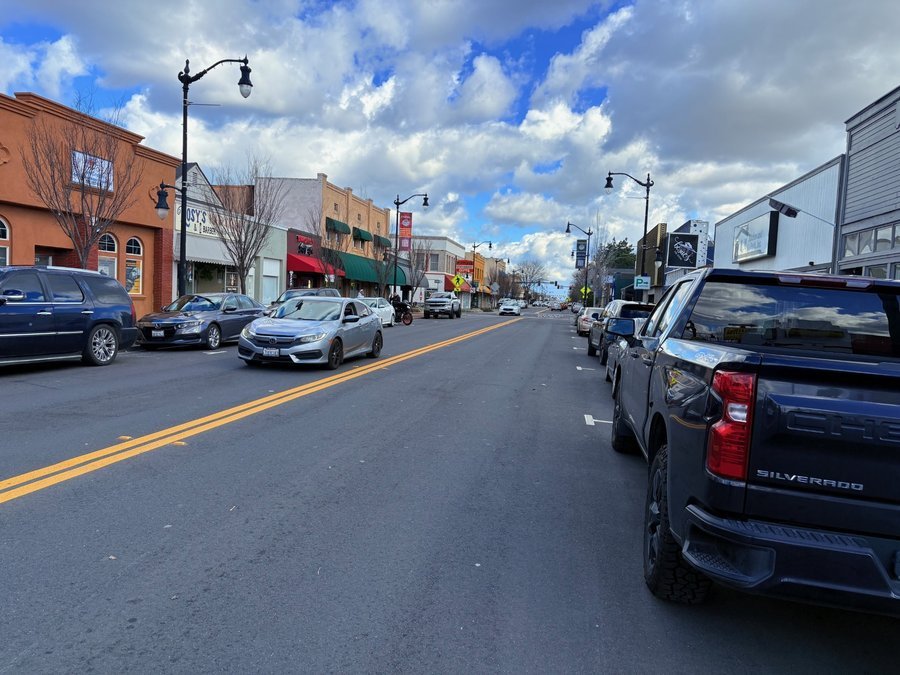
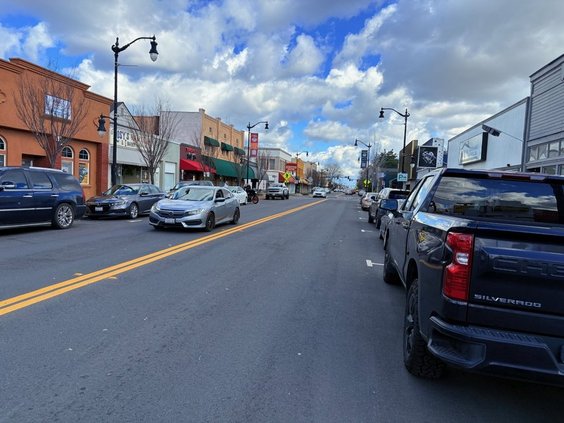
Yosemite Avenue and downtown Manteca have been synonymous for more than 100 years ago.
But the relationship has changed as the decades unfolded.
It has gone from being “the street of trade” in a fledging town with 1,206 people serving as the hub of South County agriculture in 1920 to the fourth highest trafficked east-west arterial in a city on the cusp of 100,000 residents.
In between, part of it was used to start Highway 120 that in 1933 started at the Lincoln Highway (US 50 segment) that is now Interstate 5 in Lathrop and would ultimately stretch for 153 miles through Yosemite National Park eastward to Benton where it ends at its junction with US Highway 6.
In 1976, after years of Yosemite Avenue doing double duty as a state highway, it reverted to serving as Manteca’s “Main Street” of commerce although that actual name belongs to the north-south arterial that was part of Highway 99 through much of Manteca.
The future of Yosemite Avenue is now on the proverbial planning table.
And how that future unfolds will arguably be the biggest decision Manteca municipal leaders will need to make in devising a comprehensive holistic development strategy for the city’s core.
It is a downtown core unlike any other city in San Joaquin County or those in the Bay Area that are pointed to by some as solid examples of what downtown Manteca could or should be.
What is unique is not one but two key arterials that today still pass through the heart of Manteca’s downtown.
Main Street — by traffic volume, the amount of commercial endeavors along it outside downtown, and community amenities such as Manteca High and Kaiser Hospital — makes it the city’s prime north-south arterial.
Yosemite Avenue is still a key east-west arterial but unlike the Lathrop Road, Louise Avenue, and Atherton Drive that have higher traffic volumes, it has a 1.5-mile segment in its middle between Powers Avenue that is two lanes.
That said, there are limited options thanks to the heavily used Union Pacific Railroad Fresno Line slashing through Manteca at an angle including the Main Street and Yosemite Avenue crossings in downtown.
Train movements — of which they are currently up to 40 a day with more coming — backs up vehicle traffic on both streets.
It is the reality that Ascend — the planning firm the city hired for $960,000 to do the heavy lifting in terms of exploring options and then helping the community shape a plan for downtown that includes a guide, if you will, on how to work toward turning it into a reality — is working with.
Going through all possible
scenarios for downtown streets
City Manager Toni Lundgren confirmed Ascend is currently going through a wide variety of options regarding streets in the downtown district, analyzing them, outlining pros and cons, and weighing them against stated city goals as the initial steps in devising plans.
This explorations include, but are not limited to:
*Creating a second north-south one-way street downtown.
*Exploring ways to make alleys more effective for downtown.
*Modifications to Main Street as it passes through the heart of the city.
*Discouraging through traffic on Yosemite.
The last point is arguably the biggest question that needs an answer when it comes to streets downtown.
A downtown redo needs a public canvas to work in order to transform how downtown is viewed and used by the community.
The existing streets — dimensions and such — well served the retail and dining sensibilities of the 1950s and much of the 1960s.
That’s not the case today where modern retail whether free-standing or part of center-style development — caters heavily to parking in close proximity to store entrances.
Or they are designed for speed and convenience so people don’t even have to get out of their vehicles to get a meal, pick up prescriptions, or bank.
Building on ‘good vibes’ to
spur downtown success
Downtowns can’t compete with shopping center unless, of course, cities bulldozed building on a wholesale scale and rebuilt them with massive parking lots steps from the front door.
Downtowns that are repurposed as a gathering place with “good vibes” that offers enticements to spend time, walk around, and explore provide the foundation for the best results.
The city, in buying two IOOF Hall and the corner parking lot, has obtained space for such an effort.
And while it is high profile and central, it is limited.
What Manteca needs is to create a version of First Street in Livermore or— using non-downtown example that emulates the same concept — Santana Row in San Jose that reflects Manteca’s lifestyles, sensibilities, and realties.
North Main Street’s use for that purpose is limited mainly because there is no real way to divert through traffic around downtown without either severely damaging the quality of life of adjacent neighborhoods or taking out dozens of existing homes.
Either option is extremely expensive and would create extremely fierce pushback making it next to impossible to pursue.
Center Street is wide and therefore able to be molded but current lacks an intense concentration of commercial activities.
Yosemite Avenue, by contrast, generally represents the emotional face of downtown and has a high concentration of existing buildings that have architectural character light years away from, modern sensibilities.
To turn Yosemite into a canvas — whether it is by widening sidewalks, creating mini plazas for events, adding shade trees that actually make it tolerable in the Central Valley from mid-spring to mid-fall, or allowing the creation of outdoor dining with possible future conversions of buildings into restaurants, or even making parking easier — requires getting through traffic off Yosemite.
Viable solution for
Yosemite Avenue
A solution that has garnered support from a number of elected leaders in recent years — including current Mayor Gary Singh and former Mayor Ben Cantu — is to extend Moffat Boulevard west from Main Street to Yosemite near Library Park.
The city owns adequate right of way between the Tidewater and the railroad tracks for a lane in each direction.
Traffic going to and from Spreckels Business Park where Home Depot and Target are located to west Manteca, would use Spreckels Avenue to use Moffat.
Moffat is a wider corridor.
The city then would take Yosemite from Powers to Library Park and rethink it as being primary a street serving downtown and not to handle through traffic.
The extension of Moffat would be adjacent to an existing city parking lot behind the 200 block of West Yosemite.
That would also allow businesses on the south side of West Yosemite to add rear entrances.
To contact Dennis Wyatt, email dwyatt@mantecabulletin.com