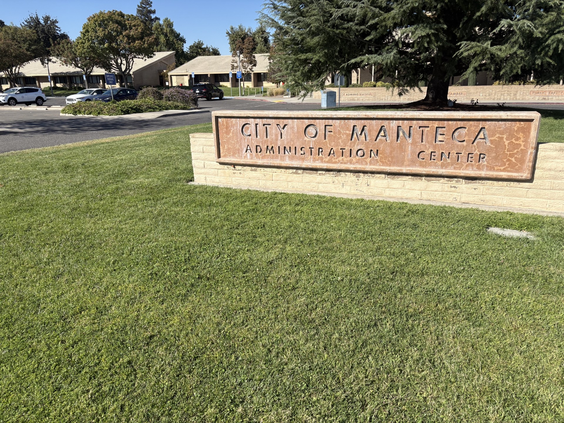
Non-functional grass at the Manteca Civic Center needs to go.
Semantics should not enter into the intent of Assembly Bill 1572 adopted in 2023.
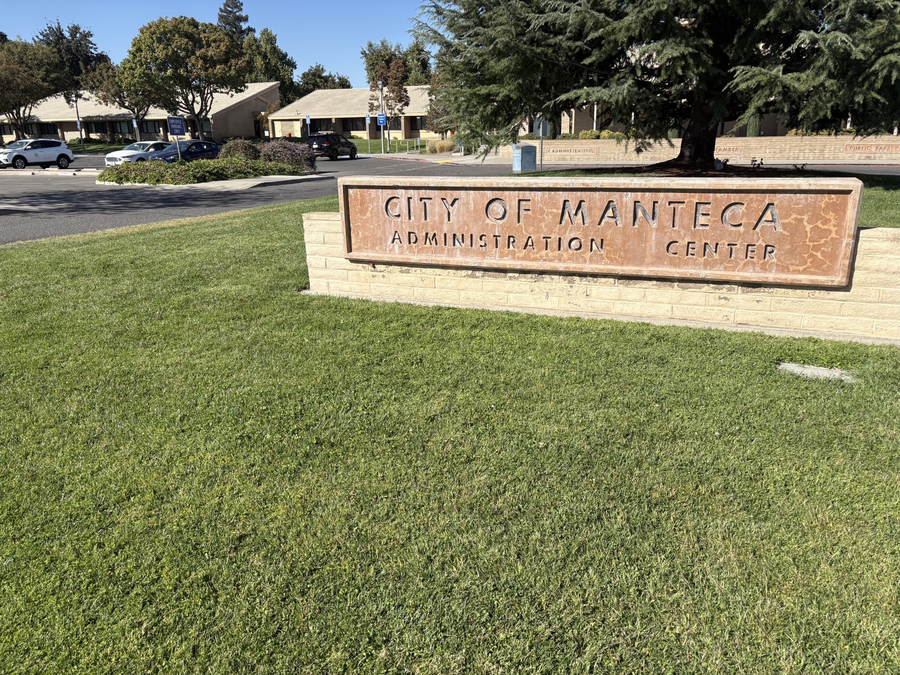
The grass areas in question — around the monument sign entrance to the parking lot off of Center Street, between the sidewalk/parking lots, and on the corner of Magnolia Avenue and Eucalyptus Street — are clearly non-functional turf that is regularly mowed as defined by the state.
As such it needs to be replaced with landscaping that consumes less water than grass.
The city is gearing up to enforce the state mandate that requires non-potable water to irrigate non-functional turf on all commercial, industrial, and institutional properties that must comply by Jan. 1, 2028 with California’s water conservation edict.
Keep in mind that ornamental grass can still be used if it is being irrigated with non-portable water which means it is not suited for drinking.
Assembly Bill 1572 is far from government overreach.
Water is a community asset.
Water is critical for people.
Water is expensive.
Watering non-functional ornamental turf or grass accounts for half of the urban water use in typical communities in the Central Valley.
And in the geographical area we call California, water supplies have been subject to prolonged periods of drought stretching over years to half a century.
The advent of today’s civilization required the creation of more than 1,300 reservoirs in California plus an elaborate conveyance system including siphoning water from one basin to another.
It is why water conservation measures are necessary and — in many cases such as Assembly Bill 1572 — mandated.
The city has done a solid job of taking measuring to replace grass in street right-of-way — think landscaped medians and those along sound walls — with shrubs and trees.
That is required by a looming deadline in 73 days on Jan. 1, 2027 that applied to all properties owned by local and regional public agencies.
There has been no movement, however, on making areas at 1001 West Center Street compliant with that fast approaching deadline as they start the first step to work toward private sector compliance in just over 14 months from now.
Not only does that ornamental grass at the Civic Center swill water in large amounts to keep green, but city employees are being paid as much as $32 an hour plus benefits to mow it every few weeks or so.
This is the same city, by the way, that has gone beyond state water conversation rules when it comes to new homes and their front yards.
All new homes built in Manteca since July 2016 have been restricted from having more than 25 percent of their front yards planted in grass. That action came in the middle of a multiple-year drought.
It is one of the main reasons Manteca’s per capita water consumption has steadily dropped over the past decade as the city added roughly 7,000 new households.
When that rule was being vetted at the Planning Commission level, then commissioner Eric Hayes made an astute observation that has been correctly saddled since then with a big asterisk.
Hayes noted the high non-potable water level where he lived at the time where the southwestern ramps of the McKinley Avenue/120 Bypass interchange are today was at 5 feet.
He characterized the city’s limitation on ornamental grass in front yards as government overreach as the city could always use groundwater to supplement drought stressed surface water supplies.
Hayes was one of two planning commissioners voting against the measure that was eventually adopted by the City Council at the time.
The big asterisk is the state has finally mandated that steps be taken to make sure groundwater use in a given year does not exceed the amount that is replenished.
The ground is not a bottomless source of water.
The water table the City of Manteca accesses for drinking is much farther down than the one that Hayes referenced 5 feet below the surface.
And it has a large degree of natural filtration thanks to the various soils water passes through on its downward journey.
That’s not the case for near surface water tables that also are extremely unreliable even just over a course of a year.
Tap into that non-potable water as the city is doing with shallow wells at some of its parks or find non-potable water from another source so it doesn’t endanger the supply of water from underground or on the surface that is needed to sustain cities, farming, and even nature.
The city needs to remember it functions as a water agency with 30,000 customers and growing.
As such, it is just like the South San Joaquin Irrigation District that 13 months ago removed all non-ornamental grass in its landscaping at their headquarters just east of Manteca along Highway 120.
Water agencies need to lead by example and not default —inadvertently or not — into Philadelphia lawyer hair splitting mode.
The language of Assembly Bill 1572 seems clear enough to a layperson.
That said, there should be no question of the law’s intent.
The ornamental grass at Manteca’s city hall needs to go.