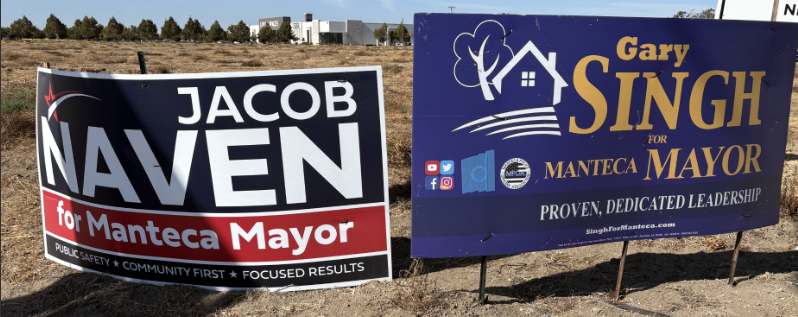
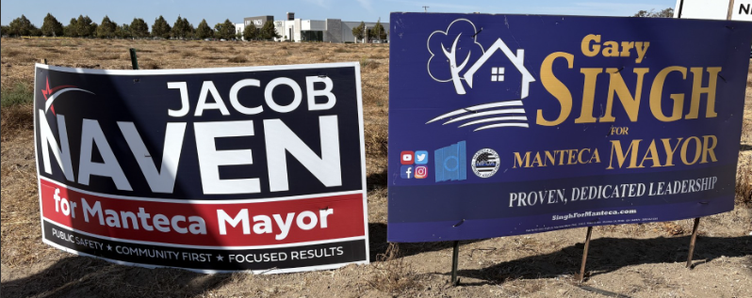
A political action committee supported in part by contributions from builders of four new home developments in Manteca and backs only Republican and independent candidates is spending $15,000 to defeat Manteca Gary Singh in his bid for a second term in the Nov. 3 election.
The California Homeowners Association Political Action Committee (PAC) — that shares the same treasurer as Jacob Naven’s mayoral campaign — filed paperwork on Oct. 8 regarding their digital video blitz taking place in the final weeks of the campaign.
Over the years, the largest contributor to the PAC has been the Building Industry Association of Southern California. The overall donations from the BIA reached $330,000 as of June 30, 2026.
The BIA of Southern California board membership includes representatives of Pulte Group, Taylor Morrison, Trumark and Lennar Homes that are home builders in Manteca.
Lennar is building the Cedar Point neighborhood on Austin Road.
Pulte as well as Tayor Morrison has new homes in Oakwood Trails in Southwest Manteca.
Trumark is building new homes in The Collective on Louise Avenue east of Highway 99.
Singh has accepted no campaign donations this election cycle from developers.
The $15,000 effort targeting Manteca’s incumbent mayor, according to filings required by the California Fair Political Practices Commission, is for the purpose of producing digital videos in opposition to Singh and buying placement across various platforms.
It marks the first time in Manteca campaign history that an independent PAC has financed a targeted campaign in a local election beyond making a contribution to a specific campaign or adding a candidate’s name to one of their mailers.
Those often includes those running for federal, state, county, and local races as well as regarding specific votes on propositions.
Independent PACs are not controlled by a specific candidate and as such they do not have to endorse their messaging. That essentially provides deniability of whatever the PAC’s message is specifically.
The only tie between Naven’s efforts and the California Homeowners Association PAC is Kelly Lawler — a political consultant out of Hilmar in Stanislaus County listed with the FPPC as their treasurer for both the pro-developer PAC and Naven’s campaign.
Some, but not all, developers have been grumbling about efforts by Manteca — led by Mayor Singh — to step up how much money new residential projects invest in Manteca beyond growth fees for parks, fore, roads, and associated infrastructure.
Why some developers are
not big fans of Mayor Singh
Singh, along with District 4 Council Mike Morowit who is also up for re-election on the Nov. 3 ballot, are on the council economic subcommittee that has been negotiating with developers in a bid to “make growth pay its own way.”
Those efforts have included things such as:
*A 147-home subdivision proposed on Sedan Avenue in South Manteca that developers have agreed to pay $16,000 per home for community benefits beyond growth fees.
*Doing off-site work indirectly associated with developments such as widening Main Street from the 120 Bypass to Woodward Avenue and then being reimbursed by other developers when they build on parcels that benefit from the work or are repaid from Public Facilities Implementation Fees assessed on all new growth. That is allowing the city to reduce the piecemeal widening of streets required to accommodate growth.
*Having the developer of Cedar Point agree to widen the western half of Austin Road south of Yosemite Avenue to the southern border of their project to two lanes southbound complete with sidewalks as well as relocate PG&E poles on their own dime. It also includes median improvements and paving one new northbound lane.
*Having the developers of the 818-home Lumina at Machado Ranch neighborhood now under construction on the southwest corner of Airport Way and Woodward Avenue pay per home fees on top of other growth fees that will allow the city to add a solid waste collection truck as well as a $1.2 million fire engine with costing existing taxpayers.
*Requiring developers that want to access the Statewide Community Infrastructure Program (SCIP) to use tax-exempt bonds to agree to place new neighborhoods into an overlay community facility district that assesses future homeowners in new neighbors annual taxes in perpetuity to finance additional police and firefighters plus cover future street maintenance in their neighborhoods.
Three of the four new sworn police officer positions Manteca started the process of hiring for in August are the result of action the City Council took several years ago to impose a perpetual overlay community facilities district (CFD) fee on all new residential subdivisions submitted to the city on their watch.
That has helped to bring the Manteca Police forced to 88 officers. As such, the city has added 11 more police officer positions since Singh was first elected mayor four years ago.
The overlay CFD tax could easily add 2 to 3 new officers/firefighters annually at the current growth rate in addition to other officers and firefighters that increases in general fund revenue would allow.
The SCIP mechanism shifts much of the infrastructure work to build a new subdivision as well as some of the growth impact fees onto the back of those that are buying the homes developers are building and selling homes to instead of the developer having to borrow the money to do the work.
That means developers can avoid have to borrow millions upon millions of dollars upfront to build, streets and install sewer water, storm, and other utility lines in subdivisions they are building.
In order for developers to use SCIP financing, state law requires local jurisdictions to agree to allow it to happen.
The city has used the desire of developers to reduce their upfront costs and make projects pencil better for them financially to help the city close a gap growth has created in public safety funding and other needs by past city polices that a previous mayor repeatedly pointed out was “leaving money on the table.”
Policies pursued by Singh and the current council is reversing that decades old trend.
The SCIP program has assisted communities and developers throughout California to finance over $1 billion in impact fees and public infrastructure since 2003.
Lawler was part of last
effort to recall Newsom
Lawler was treasurer for Recall California — that last effort to recall Gov. Gavin Newsom — until March 2024 when reports at the time indicated she was receiving calls from key Republicans asking her to do so.
A similar campaign that reached the ballot in 2021 failed.
Lawler is owner and treasurer of the KAL Group founded in 2004 provides campaign treasury services, FPPC and FEC campaign finance reporting, full-service bookkeeping, and back-office support. It has assisted over 1,000 candidates and committees.
The company’s website indicates they serve Republican and independent candidates nationwide.
Based on data gleaned by Transparency USA, the California Homeowners Association PAC has collected $1.7 million in donations as of June 30, 2026.
Over the years, the largest contributor to the PAC has been the Building Industry Association of Southern California. That BIA has accumulatively contributed $330,000 to the PAC to support or opposes various candidates and local ballot propositions.
To contact Dennis Wyatt, email dwyatt@mantecabulletin.com