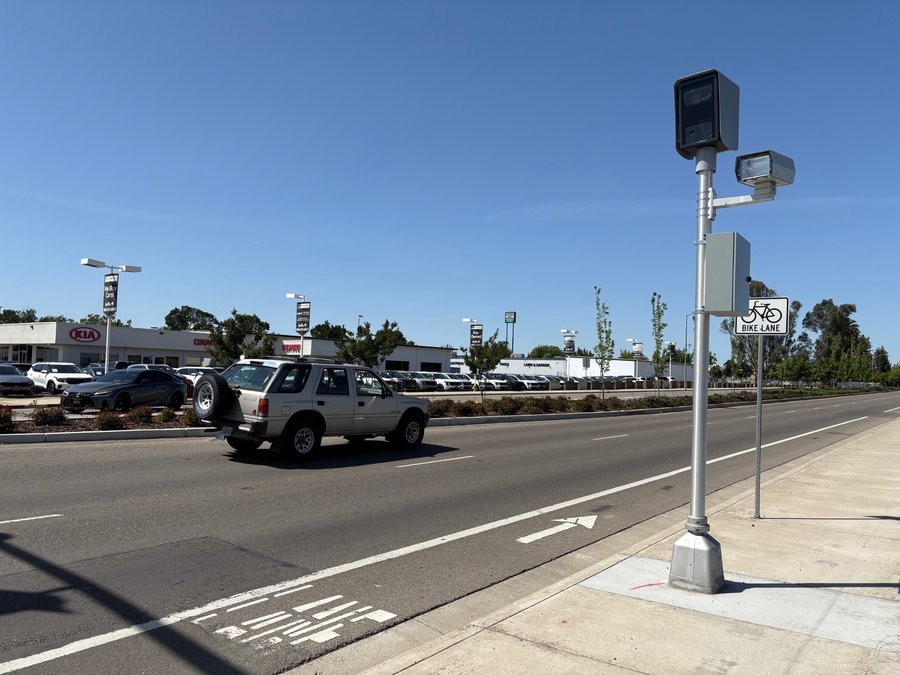
Jacob Naven knows the impact red light tickets — the majority of which are red turn violations — are having on families.
Naven — an insurance agent who is running for the Manteca mayor’s post in the Nov. 2 election— has had clients that have received the $490 tickets issued via the city’s red light camera technology.
Among them are those that received two tickets in quick succession, both involving the still illegal but statistically less dangerous “rolling” through a right turn on a red light at a relatively slow speed.
The $980 hit for the two tickets was just the beginning. As the result of the multiple tickets, some are seeing their auto insurance premiums double.
The mayoral candidate understands the need to enforce vehicle code using proven technology.
“I’ve had clients (over the years) lose their lives to T-bone crashes and DUIs,” Naven said.
What he doesn’t understand is why Manteca hasn’t opted in yet to use a state law that went into effect in January to change the 900 to 1,000 or so red light violation tickets they are issuing monthly from a moving violation to a citation.
Not only does it lower the cost from $490 per offense to $100 for the first offense with an upward sliding scale for subsequent violations over a three year period, but it wouldn’t generate a point on their driving record that could cause their insurance premiums to soar.
Naven understands city concerns that they don’t want to open themselves to potential financial liability via their contract with American Traffic Systems. As such, the city needs to make sure they are on firm ground before they opt in to issuing citations instead of moving violation tickets.
But given it’s been almost seven months since the law was signed by Governor Newsom and almost four months since it went into effect, Naven believes the City Council has had plenty of time to make it clear what red light ticketing path they support going forward.
Councilman Mike Morowit, for one prefers the city to opt in, if they can.
Manteca, Modesto, and Tracy are all using red light camera enforcement systems contracted with firms when the moving violation was the only penalty on the table in California for red light running.
Senate Bill 720 changed the dynamics by establishing a $100 citation alternative that cities using automated traffic enforcement systems could opt in to use. It does not mandate that cities do so.
Given the income neutrality provision of existing state law that requires contracts with vendors that install automated traffic enforcement systems not to cost jurisdictions any money if the cameras fail to cover the entire cost of the contract for the services doesn’t make ticket revenue the issue, the bottom line for cities is whether opting in somehow would be viewed as a breach of contract opening them to litigation.
Morowit said the city has made it a priority to address the opt in option but the departure of the city attorney earlier this year has slowed down resolving key questions that need to be answered.
From the city’s financial viewpoint, it likely won’t change what they receive every time a valid violation occurs.
That’s because the $490 moving violation ticket includes a large cut the state takes with other court fees and surcharges. Local jurisdictions end up with roughly 20 percent of the $490 moving violation ticket.
The citation option cuts out the court system with 100 percent of the fine going to the city.
The city would also handle the processing of the tickets and collecting of fines.
The amount the city collects per ticket would stay roughly the same is they opt in for the $100 citations.
The city is working to determine if a ticketed offender doesn’t pay the $100 citation whether it can be made collectable when vehicle registration fees are renewed as is the case with parking tickets and Fast/Trak toll charges.
The Department of Motor Vehicles can’t issue new registration tags until parking tickets and such are cleared with the agencies that issue them.
Using the DMV renewal process would mean failure to renew registration can lead to impounding of vehicles after six months after tags have expired. It would be the ultimate fallback for unpaid automated red light system issued ticket collection.
The city would also need to have an appeal process in place as citations, unlike moving violations, are not handled by the court system.
Under the opt in, the initial violation is $100. Then if there is a second violation within three years it is $200, a third violation it is $350, and a fourth violation it is $500.
“The city needs to make it right,” Morowit said.
Morowit said that means enforcing the laws but not in a manner that is not overly punitive in terms of its financial impact.
To contact Dennis Wyatt, email dwyatt@mantecabulletin.com