Manteca is taking a proactive instead of a reactive approach to its pending animal shelter expansion.
And in doing so it will:
*avoid spending millions upon millions in tax dollars.
*help reduce the number of unwanted cats and dogs.
*make it easier for domestic violence victims to seek help.
*support the city’s high priority effort to get the homeless off the streets.
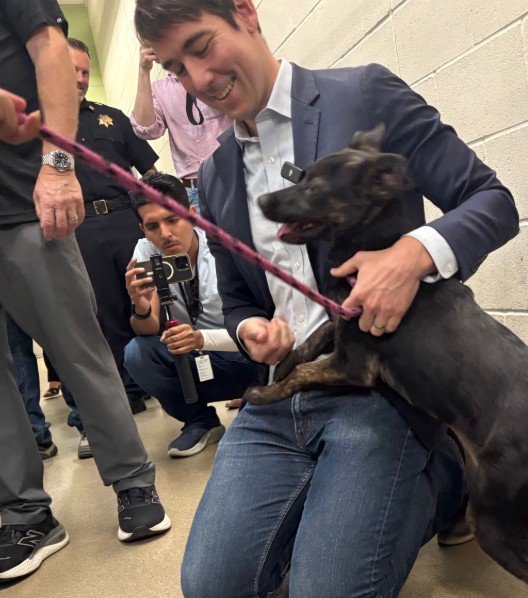
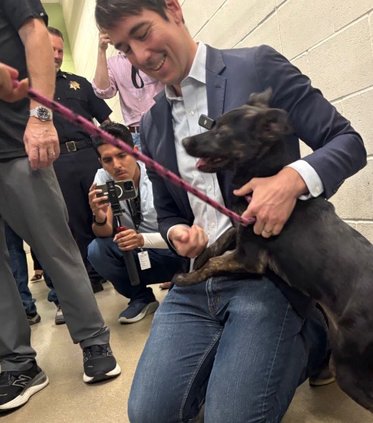
Congressman Josh Harder on Thursday presented Manteca leaders an $850,000 check from the federal government that City Manager Toni Lungren indicated will cover a lion’s share of the expansion strategy.
It also helps that Antonini Trucking donated the Holding for Home component aimed at helping domestic violence victims and the homeless.
Harder, in securing the earmark, lauded the humane approach Manteca is taking.
There are two elements of the expansion.
One is establishing a contracted veterinary clinic fashioned from shipping containers and the other are holding home dog kennels.
Kennels for dogs of homeless
and domestic violence victims
This week, a container-style holding home with air conditioned and heated kennels for 10 dogs along with a run donated by Antonini Trucking, is being delivered to the homeless emergency shelter at 555 Industrial Park Drive.
“Those in domestic violence situations are more likely to leave knowing their pets will be taken care of,” noted Police Chief Steve Schluer.
A set number of the kennels at 555 Industrial Park Drive will be reserved for the pets of domestic violence victims.
Emergency shelters for abuse victims do not typically allow dogs.
Dogs will stay there free of charge until their owner is able to care for them.
The police chief said the owners will be able to visit their dogs.
As for the homeless, Schluer said those on the streets are reluctant to go to the shelter if they can’t take their dogs.
“They (the homeless) take better care of their dogs than themselves,” Schluer said.
The homeless will be able to have their dogs with them but at night their pets will sleep in the kennels.
On-site contracted
veterinary clinic
The grant will fund most of the cost for the veterinary clinic.
The city, instead of simply adding kennels to hold more animals, wanted to address a root cause of unwanted pets which is the lack of low-cost spay and neutering services in Manteca.
The clinic is targeted for opening in the fall of 2027.
Besides spay and neuter services it will allow for other low-cost veterinarian services, vaccinations and parasite prevention, and microchipping to reduce the stray population.
It will include exam rooms, a surgery area, cat and dog kennels, recovery area, bathroom, reception area, and a room for a washer/dryer and surgery.
Friends of the Manteca Animal Shelter will provide Holding for Home units at the shelter.
The clinic project also has other pet-related non-profits helping move it forward.
No-kill shelter
The Manteca Animal Shelter attained no-kill status two years ago.
That means at least 90 percent of the dogs and cats that end up at the shelter are returned to their owners, are adopted, or placed with a rescue organization.
Becoming a no-kill shelter was one of Schluer’s goals when he became interim police chief in December of 2022.
The no-kill rate is currently at 92.5 percent.
Those killed also include sick and injured animals.
Remove those and the no-kill rate would soar to 99 percent given only two healthy dogs that couldn’t be placed were put down last year.
The establishment of a robust volunteer organization — the Friends of the Manteca Animal Shelter — has played a big role in the turn-around of the shelter.
Not only do they provide volunteer manpower and augment funding, but they have put in place programs where volunteers take dogs out for walks and such to reduce kennel stress to fostering programs for short periods of time when the shelter had no space.
Additional staffing
The animal shelter currently has four animal control officers and four part-time kennel assistants.
Lundgren said there are plans to add a part-time rescue coordinator and other part-time kennel worker.
The rescue coordinator is a key position that works with various rescue groups in the area — as well as throughout Northern California — to find space for animals that the shelter is not able to adopt out in a timely manner.
The current shelter
The current shelter has:
*Two separate dog rooms. Each has 13 individual kennels designed with a door that slides up in the middle of each run. That allows doubling the available space for up to 52 dogs if needed. The kennels have a system where urine and smaller fecal matter can be hosed into using the wand system after larger droppings are collected.
*There is a separate room where animals — when needed — can be put to sleep.
*There is an examine room for treating animals.
*There are two cat rooms of which one is for the isolation of sick cats.
*There is an outside holding pen for larger animals.
*There is an extensive exercise area outside for dogs.
The design employed all of the latest standards adopted by the Society for the Prevention of Cruelty to Animals when the animal shelter opened in 2011 at a cost of $2.1 million.
To contact Dennis Wyatt, email dwyatt@mantecabulletin.com