Manteca Police — due to the dedicated efforts of three trained volunteers — tagged roughly 1,500 vehicles for exceeding the city’s on-street parking limit of 72 hours during 2025.
Of those, only 120 ended up having to be towed.
That’s great news as far as Manteca Police Chief Stephen Schluer is covered.
“The fact most people comply and move their vehicles shows enforcement works,” Schluer said.
And the other bit of good news is the 1,500 vehicles exceeding parking limits are not going unnoticed by the city thanks to the efforts of Supporting & Helping Area Residents & Police (SHARP) volunteers.
Giving it is a low-level priority, enforcing the street parking time limit would not be as intense without the SHARP volunteers. That would mean parked cars could linger on streets for months.
SHARP is an appropriate acronym for the currently 25-member strong volunteer group given the key roles they play in combatting graffiti, removing the illegal placement of yard sales and advertising signs in municipal right-of-way, as well as vehicle abatement.
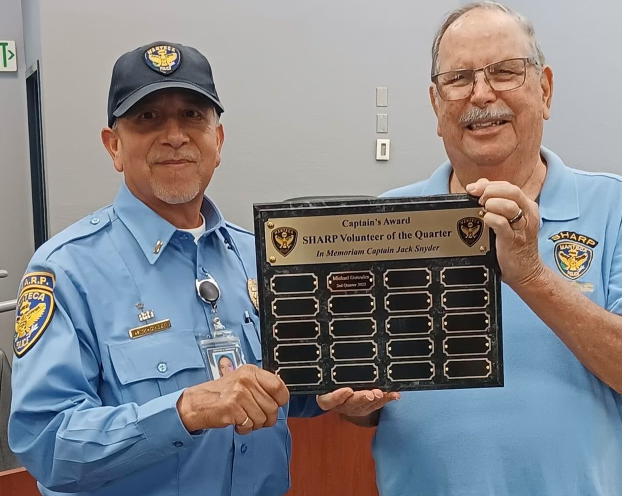
SHARP leaders Richard Silverman and Mike Gonzales on Thursday shared with Manteca Rotarians what the group does and how more volunteers could help them do an even better job not just keeping Manteca clean but freeing up police officers for more pressing tasks.
“We try to help the police department as much as we can with non-hazardous work,” Silverman said.
The most critical impact is what trained SHARP volunteers can do to free up officers to do more pressing police work.
That list of tasks includes — but is not limited to:
*Working traffic control at accidents, major fires, and such.
*Assisting with road closures for parades and events.
*Doing “mail” runs between the police department, district attorney’s office and the courts.
*Documenting graffiti and — in the case of that on municipal property — painting over it.
*Removing yard sale signs and advertising that can’t legally be placed on city property.
*Vehicle abandonment enforcement.
“Contrary to misconceptions, SHARP doesn’t issue tickets,” Silverman said.
They are, however, trained in the basics by police officers for their supportive roles whether it is the proper placement pattern for flares as well as hand signals for traffic control at road closures to following the procedures to legally mark vehicles complete with a warning sticker on the window for cars to be legally considered abandoned.
Silverman said when SHARP acts on a citizen complaint about an abandoned vehicle whether it is routed to them by the government outreach act or a non-emergency call to the department, they don’t determine that it is by weeds growing under the car in pavement cracks, trash piled on the hood or windows covered in dirt.
They are properly marked on the tires and a checklist followed.
Silverman said the department isn’t alerted by SHARP volunteers that 72 hours have passed since a vehicle was marked and a sticker attached to the window until at least 72 hours later “and not a minute sooner.”
He did note the exception are vehicles found with registration six months overdue that can be subject to immediate towing by the police.
SHARP volunteers also help support the understaffed code enforcement division 2 to 3 times a day by photographing property the city receives a complaint on and then doing follow-up photographs for compliance.
That helps speed up the process for code enforcement. The actual determination of a violation and the remedy is still left to the code enforcement officers.
Graffiti skyrocketed
during the pandemic
Graffiti throughout Manteca seemed to skyrocket during the pandemic as it lingered a significantly longer time as the shutdown forced the suspending of SHARP volunteer efforts.
It plunged after the SHARP unit resumed operations.
Graffiti abatement has been credited almost since the year SHARP unit was formed in 1988 as the most visible impact on Manteca that the volunteers have.
Other tasks the SHARP do on a routine basis are vacation house checks, daily neighborhood street patrols to provide police with “extra eyes”, low-level data entry, as well as to assist with searches for missing children and adults.
They also have a rapid response team trained and available to deploy quickly on a 24/7 basis as directed by police dispatch to any incident requiring additional traffic control to support police or fire.
That is especially critical in late night or early morning hours when there is a major injury accident or a major fire as police staffing is at its thinnest and the requires multiple-hours of traffic control.
There are other tasks SHARP has done in the last past when they had 60 volunteers. With the current 25, those tasks — such as bike path safety patrols — have been dropped.
Rebranding, how to volunteer
The SHARP unit just added three volunteers and has another three in background checks and training.
They are also rebranding by switching out “Seniors” to “Supporting &” at the start of their official name to reflect the fact that for years the minimum age to volunteer has been 40 for years, and not 50 years.
Volunteers undergo a background check and are trained for 40 hours.
All uniforms and equipment are provided.
Volunteer must be willing to be available for at least four hours a week.
Information about applying for SHARP can be found on the Manteca Police Department page on the city’s website.
To contact Dennis Wyatt, email dwyatt@mantecabulletin.com