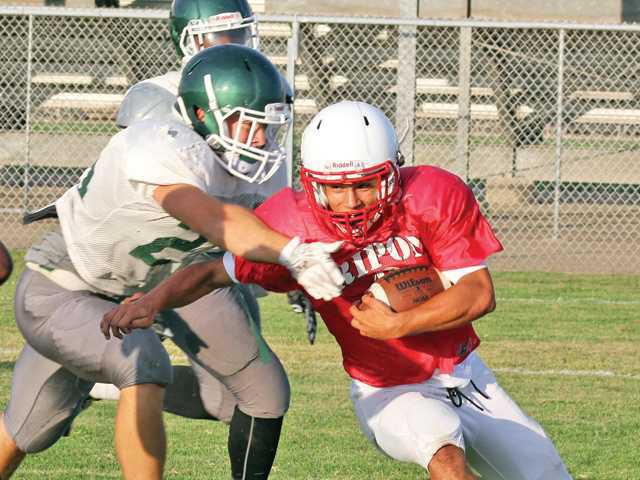
On nearly every play during 11-on-11 sessions, coaches routinely had to remind players to ease up when wrapping up opposing ball carriers on Monday — the first of three days in Manteca High’s four-team summer camp.
Things went more smoothly Tuesday as whistles blared from every direction to give defensive players a chance to throttle down and keep ball carriers on their feet.
“It’s hard,” Lathrop lineman Robert Luckett said. “Definitely an adjustment, but we’re trying to play within the rules.”
In July of 2014, Gov. Jerry Brown signed a bill that limits full-contact practices during the season and in team camps over the summer. AB2127, introduced by Assemblyman Ken Cooley, D-Rancho Cordova, is intended to help curtail concussions and other head injuries.
The new law came into effect Jan. 1 of this year. High school football teams are not allowed to have more than two days of full-contact practice, each of which cannot exceed more than 90 minutes during the course of the season. Full-contact practices are prohibited in the offseason, including camps such as the one hosted by Manteca.
Joining the Buffaloes this week are Ripon, Lathrop and Central Valley of Ceres. Sierra ends its annual camp at Stagg (Stockton) on Thursday, while Ripon Christian begins the three-day Mountain Misery Summer Camp at Central Catholic (Modesto). Last month, East Union attended a camp put on by South Lake Tahoe High.
In years past, it was common for players to go full bore in summer camps, especially during inside run drills and 11-on-11 scrimmages.
“The inside period was 45 minutes of straight hitting,” Manteca coach Eric Reis said. “Now, we’re spending 45 more minutes on tackling. We’ve lost so much contact from what we’re used to but it’s giving us a lot more time to work on fundamental stuff.
“You don’t want somebody getting hurt, so I understand exactly where they’re coming from.”
The trick, though, is to simulate game situations at lower intensity levels. To be certain of what is and isn’t allowed at these camps, Ripon coach Chris Johnson called the California Interscholastic Federation office.
Teams can still dress in full pads and work on bags and blocking sleds, but coaches at the Manteca camp were unclear on what type of contact can be made between players. Johnson said contact drills must be conducted at a controlled tempo and that a “predetermined winner” — meaning, an offensive player has the right of way against the defense — must be established. In addition, offensive linemen are not allowed to chop block, and defenders cannot take a ball carrier down to the turf.
“Everything that you’ve done for so many years is now different,” Johnson said. “It’s harder on the players because their whole life they’re being patted on the butt for going hard and getting physical, but now it’s like, ‘Go hard and be physical but don’t hit anyone.’ That’s tough.”
Johnson said he’s heard of players holding padded shields for 11-on-11s at other camps in the area.
“Are we going to go that far? If that’s the case how much value are in these camps?” Johnson said. “The fortunate thing is that Eric and I and all the other coaches are on the same page. We don’t want anyone to get hurt and we all just want to get better.”
The new rules will take some getting used to, but Reis says he is seeing the desired results.
“We’re still getting better,” Reis said. “We’re still getting something out of this.”
NO HARM, NO FOUL
Players, coaches adjust to rule changes for contact camps