Repaying what is expected to be an 18-year bond to pay for the new 46,100 square-foot state-of-the art police station is projected to cost $8 million a year.
City Manager Toni Lundgren indicated on Friday efforts are underway to make sure Manteca takes advantage of the robust AA credit rating they have established to secure the lowest possible interest rate for the $92 million project.
Measure Q revenue — originally projected to generate $13 million on an annual basis in the lead up to the 20-year, three-quarter cent sales tax vote in November 2024 — is now tracking to be in excess of $15 million a year.
The bond payment is the only reoccurring debt besides the funding of nine additional firefighter positions and three additional police officer positions tied to the 20-year sales tax.
The city plans to work on other revenue streams to cover the $2 million additional payroll cost before the sales tax ends.
The surge in commercial, dining and such will mean Measure Q receipts — as well as the city’s basis one cent general sales tax and the half-cent Measure M sales tax passed in 2026 now funding 38 of the city’s 137 frontline public safety personnel — will increase beyond the rate of inflation.
That said, there is a funding source already in place that will be available in the same year the Measure Q tax expires that would provide $1.8 million in 2026 dollars that could basically cover the payroll costs of the 12 public safety positions.
It’s the end of the tax split agreement a previous council led by then Mayor Steve DeBrum made with Great Wolf for room tax being collected on those that stay at the 500-room resort.
The city is already receiving a share of the room tax revenue split that helped snare the indoor water park. It is 75-25 in the first 10 years favoring Great Wolf. It goes to 50-50 in the 11th through 25th year and ends in the 26th year.
Going forward and doing so with constant 2026 dollars in terms of revenue and the price of commodities and construction will have $5 million plus a year going forward in remaining Measure Q to address other needs.
Lundgren noted the city intends to use the money for non-reoccurring expenditures.
That would mean — going forward except for the 12 public safety positions already funded — no Measure Q funds would be committed to paying for either new positions or for pay and benefit increases for existing municipal positions.
As an example, the city may use Measure Q receipts to bridge any amount of the cost of constructing the city’s sixth fire station that will be built in southwest Manteca that isn’t covered with growth fees for fire facilities
The Measure Q language approved by voters states it will be used for street and traffic improvements (including potholes), job creation, local business support, homeless services, youth services, enhance public safety facilities and services, and other quality of life services.
This marks the first time in 60 years — if not ever in the city’s 117-year history — that bonds will be issued against the general fund.
A built in safety measure of a having the bond tied into the expiration year of the Measure Q tax assures the city’s other general fund revenue will likely never be at risk.
It follows the same philosophy of previous councils that rejected bonding against the general fund per se in making deals to secure Bass Pro, Living Spaces, Costco and Great Wolf.
In all four cases, negotiators for those concerns pushed for some form of bonding that would have put the city on the hook if the private sector firms didn’t generate the revue to pay them off.
In all four cases, deals were made that basically gave up future revenue that each concern would bring to Manteca for a limited number of years. It is revenue, as former Mayor Willie Weatherford stressed often, that the city would never get if Bass Pro, Great Wolf, and Costco did not locate in Manteca.
What the new police
station will involve
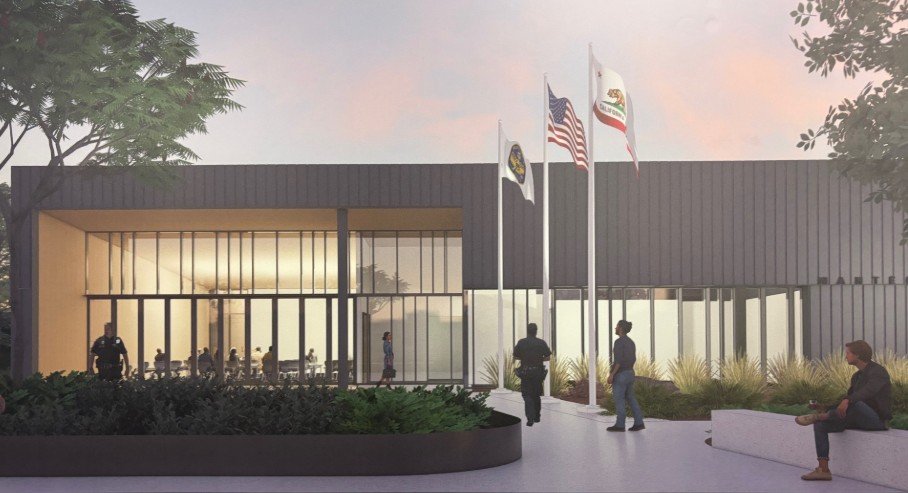
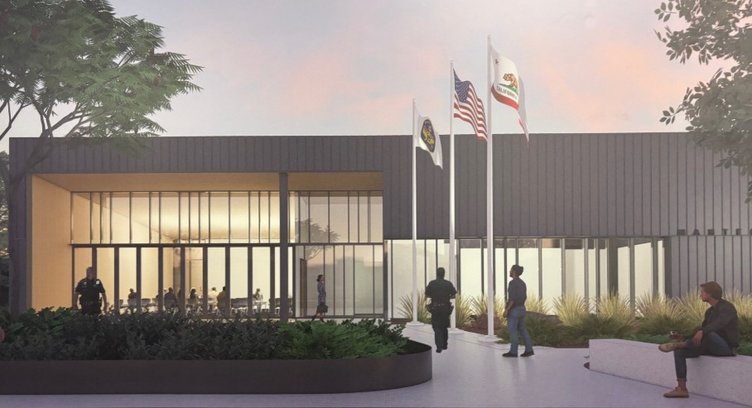
The city is now working toward a September ground breaking on four acres in the 600 block of South Main Street to replace existing 21,000 square foot station built in the late 1970s.
Since then, space needs have worsened and aging infrastructure has created more problems.
The security upgrades are numerous. And it is more than just bullet proof glass.
The station, as an example, will be secured behind an 8-foot concrete masonry with wrought iron railing on top.
It’s a significant upgrade from the current wrought iron fence with large gaps between bars where — in the past — people have been able to reach over the top to unlock gates.
That said, the city worked to keep costs down without sacrificing security and function.
One example is instead of a sally port — a secured area where suspects can be transferred to and from vehicles — there will be a sally court.
It will still have walls and doors that can be secured once a patrol unit is inside.
But by going sans roof — which would have required mandated and expensive exhaust systems to deal with vehicles — the cost was reduced significantly. Instead, it will have a canopy style roof.
There is also a 3,000 square-foot outbuilding designed for storage that isn’t mandated to be in a police structure designed to higher seismic standards due to it being a vital public safety building.
The outbuilding will also house two kennels as a respite for police dogs when their officer partner is busy handling paperwork and such inside the police station.
The end result is 3,000 square feet of needs will cost less than adding it to the 46,100 square-foot police station that is being built.
Community room doubles
emergency operations center
As you drive by on Main Street, the northern side of the façade will include a community room with a large glass wall adjacent to the lobby.
The space will do “triple” duty.
It will be available for community non-profits to use as well as for police outreach programs to address ways they can keep their families and neighborhoods safe.
It will also be wired for quick conversion to an emergency operations center.
That means instead of commandeering other space and temporary wiring it for a command center in an emergency, the public safety personnel can do a much quicker transformation of the community room.
The city had a makeshift emergency command center during the 1997 floods, the COVID-19 pandemic, and during PG&E public safety power shutdowns.
The layout is being done so the public doesn’t need to pass through secure areas when they ushered in from the lobby to conduct business.
An example is those who have to register as sex offenders. They can use a back entrance to access an area being put in place for such purposes.
There will also be touches such as a “soft interview room” where crime victims or children can be interviewed in a less intimidating setting complete with couches and chairs.
Using drones as the first
responders & trans officers
The station will have a real time crime center where an officer can access cameras across Manteca when a serious crime is reported. It will allow the police department to make a drone the first responder.
That will allow police to have eyes on a crime scene or a fleeing suspect while officers are responding.
It has been used successfully by other departments to basically zero in on where suspects have gone — over fences, behind building, and such. It has been proven to increase arrests as well as enhance the safety of officers and bystanders.
To contact Dennis Wyatt, email dwyatt@mantecabulletin.com