Jerry Barton was on a mission.
The almond and walnut grower was preparing 24 years ago to build a new neighborhood adjacent to his ranch at the eastern end of Milgeo Avenue in Ripon.
He wanted to find out “what got people into their front yards” to mingle with neighbors.
Jerry traveled to 14 neighborhoods in San Joaquin and Sacramento continues and found the key in one word — trees.
Not just any trees, mind you.
They had to be trees that would grow tall and provide expansive canopies with inviting shade for strolls, for kids to kick around a ball on a summer day, and to minimize the harshness of asphalt when it came to heating things up and overall aesthetics.
The tree he came up with was the sycamore.
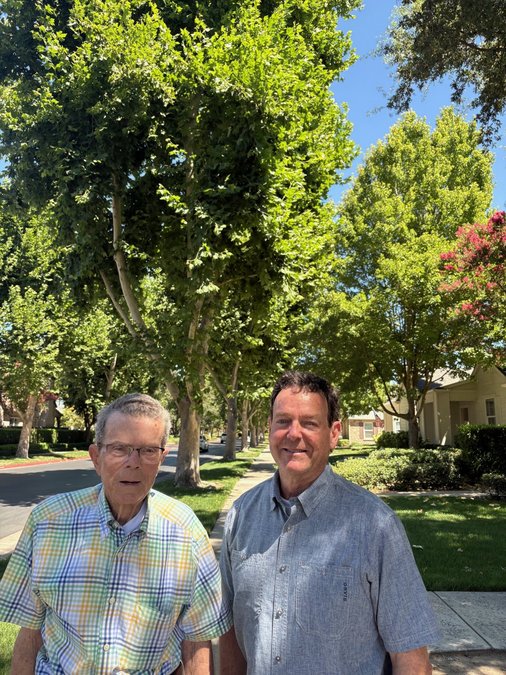
On Wednesday, some 23 years after the first foundation was poured, Jerry and his son Gary — who serves as Ripon’s mayor — stood under the shade offered by some of the roughly 200 or so sycamores that were planted in the Seven Oaks gated community.
The air temperature was almost a good 10 degrees cooler than several blocks away on Milgeo Avenue west of Murphy Road where the pavement baked under the 90-degree heat of the day.
The father-son reverence for trees extends far beyond the walnut, almond and olive orchards that provide a livelihood or even the sycamores that have transformed Seven Oaks into more than just a cookie cutter subdivision.
Seven native oaks — hence the name — were transplanted from the adjoining ranch and are still woven into common areas including small parks in the middle of the street.
Gary notes the value of the sycamores goes beyond enticing people outdoors and interacting with neighbors.
They minimize hot pavement that absorbs heat and increases ground temperatures as well as the amount of electricity needed to cool homes.
And, from a financial perspective, big healthy shade trees add to property value.
Gary believes Ripon is fortunate to have a municipal planning director like Ken Zuidevaart “who loves trees” and understands their value in helping create livable neighborhoods.
As for city development overall, he believes Ripon has done a good job although he’d like to see developers step up their game even more when it comes to street trees.
He understands the reluctance of some city planners to go for more than just one-dimensional trees that are more for model yard looks for a couple weeks a year and offer minimal shade at best due to issues of roots potentially raising havoc with sidewalks.
Gary points out that is problem that can be virtually eliminated by taking the lead of almond growers that depend on maximizing healthy trees by planting methods that allow for loose, aerated soil so roots can spread and go deep.
“The land is greatly compacted to prepare it (for home building),” Gary noted.
In new developments, trees are almost always planted in the same compacted ground instead of taking steps to make it more conducive to produce large and healthy trees with minimal root issues.
Seven Oaks evacuated ground for each tree.
And 20 plus years later the results lure walkers morning, mid-afternoon, and evening for pleasant strolls. It also has led to a pleasant and comfortable environment that brings neighbors together.
“It’s not that expensive,” Gray said of the trees and proper planting especially given the long-term outcome.
What is in place today could even be more effective with the proper equipment.
The property management firm the homeowners association uses obtained a landscape maintenance company that only has a 60-foot boom truck.
If they had an 80-foot boom there would have been no need to top the trees recently to allow for ongoing care to be done property.
Gary gets that sycamores can messy.
They are among a handful of tree species that shed their bark,
But that drawback is easily countered not just by fairly rapid and strong growth but the fact botanists have determined sycamores have a high tolerance for air pollution making them the ideal urban candidates to absorb carbon and generate oxygen.
The 14 neighborhoods that Jerry inspected included Sacramento’s Fabulous Forties near Mercy Hospital in the Capital City.
Jerry and his wife of 71 years, Janet, recently returned to that neighborhood. He noted the canopy covered streets are as inviting as ever and the upkeep of the aging homes reflects the strong sense of neighborhood pride that he had hoped to bring to Seven Oaks.
Others among the 14 neighborhoods that helped inspire the Seven Oaks design that was built on long narrow parcel wedged between Milgeo and the Spring Creek Country Club included the Graceada Park area in Modesto, near the old Lodi High campus in Lodi, and near the older Modesto Junior College campus, among others.
Gary noted Seven Oaks’ design also is rooted in what you can find along Ripon streets near downtown such as Acacia Avenue with its tall trees and shady street canopy.
He also noted another advantage of Seven Oaks — it’s narrow streets.
Not does it mean less asphalt to shade, but in the long-run it costs less to maintain.
And there is another plus.
“It seems counterintuitive, but the narrower streets get people to slow down,” he said.
To contact Dennis Wyatt, email dwyatt@mantecabulletin.co