By DENNIS WYATT
The Bulletin
Going Digital is posed to literally takeoff this school year.
Manteca Unified seventh and eighth graders will use their tablets to build CanSats — satellites in a soda can — and launch them at semester’s end either using a high powered rocket launch or a high attitude balloon.
“This is great,” noted University of California third year physics major Mack Robertson who was assisting with junior high science teacher training Wednesday at Sierra High. “(When I was) in high school science classes were more like history classes where you read about things.”
Robertson said the book approach to science tended not to engage students although he was active going to high school near Princeton in after school technology clubs and the school’s Science Olympiad team.
Not being engaging won’t be the case with new curriculum Manteca Unified is rolling out thanks to the versatility of the Panasonic 3E tablets.
Sierra High science teacher Stephan Unterholzner said “I can only image” what students exposed to the Science, Technology, Engineering and Math (STEM) in the fourth through eighth grade through various applications employing the Going Digital initiative will be able to do once they are in high school.
Last school year with just having tablets for less than four months, his students undertook a wide array of projects.
Since California was in a fourth year of a drought, several students wanted to devise a watering device that could be used to determine moisture in soil and improve water efficiency. They used information accessed on their tablets as well as called on mentors outside the classroom such as from Livermore Lab to create a device for $200. Unterholzner noted Toro just rolled out a similar product using the millions of dollars in resources they have for research and development.
Other students wanted to build an electric wheelchair that responds to voice commands. After determining using an actual wheelchair would be cost prohibitive, the students used a radio controlled car and “hacked” into its electrics and then built technology that allowed the RC model to respond to their voice commands.
“I was learning just as much as they were,” Unterholzner said of his students last spring.
Unternolzner along with the 11 junior high school science teachers and other district personnel built their own CanSat under the supervision of representatives from Magnitiude.io — a San Francisco based firm that assists educators providing project-based learning experiences from the next generation of scientists and engineers. The San Francisco-based Magnitude.io team — whose model is “powered by curiosity” — was led by CEO and co-founder Ted Tagami along with two University of California at Berkeley physics students.
They took the CanSat to Hilmar Wednesday afternoon and launched it using a high attitude balloon. Beforehand, they accessed weather data ranging from winds to barometric pressure to determine the course the CanSat would take while it collected data for later use. The CanSat was expected to land near Lathrop High.
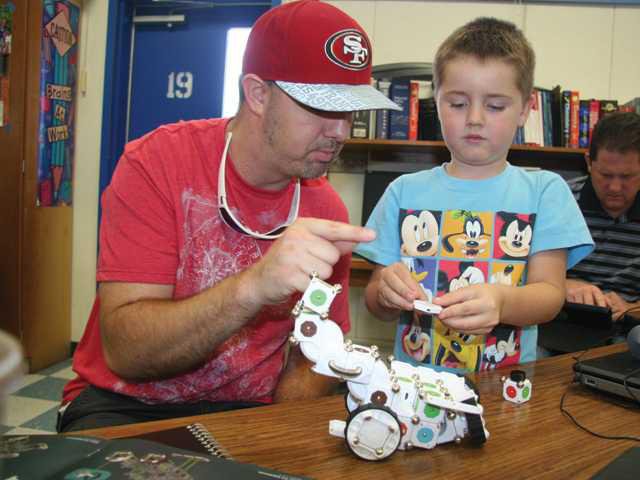
The training also covered the effectiveness of collaborative learning where students will build— including soldering — their own robots that they will also program to touch on all aspects of technology from hardware to coding.
They will be guided in part by instructional videos that interns made over the summer. The video periodically includes quizzes that students must answer before moving on. The answers are quickly noted as to whether they are correct allowing teachers to instantly determine what concepts need to be additionally addressed.
STEM married with
Going Digital for
4th thru 12th graders
Manteca Unified Superintendent Jason Messer said the STEM effort employing Going Digital is targeting fourth through 12th graders. Kindergartners through third graders will be introduced to basic concepts.
STEM education is a high priority at the federal level to produce a competitive American workforce.
“Virtually every job employs technology now,” Messer said.
Fourth through sixth graders will use tablets to learn coding and other robotic concepts. One way that will be done is employing Ozobots. They are billiard ball shaped powerful smart robots that can be used to demonstrate the concept of coding.
They can follow color coded lines to be told to do tasks such as spinning. There are apps available for the tablets students use that employ game based activities using Ozobots designed to teach students who coding works.
Messer noted the STEM program is being designed to teach science, math, engineering, and math but it also reinforces other skills such as “shop-related” learning as demonstrated by seventh and eighth graders who will learn to solder as well as re-emphasize the vital need for strong language skills
Several teachers on Wednesday said it was the first time they had ever used a soldering iron.
“Everyone is learning,” Messer said.
Additional STEM lessons and projects will be developed as teachers move deeper into the use of tablets. They will be available eventually at a site dubbed MEL’S Garage — short for Connecting Manufacturing & Engineering to Learning through STEM. The goal is to have it accessible to adult school students as well as parents working with their children.
The district has extended the STEM effort to programs being operated by Give Every Child a Chance.
To contact Dennis Wyatt, email dwyatt@mantecabulletin.com