LATHROP – Francisco Salazar wasn’t shy about wiping the sweat from his brow while he was talking about the furnace that has basically fueled the operations at NSG/Pilkington for the last five decades.
It’s a necessity when the growling piece of machinery behind you is throwing out temperatures near 3,000 degrees.
With the family members of plant employees in tow, Salazar – an industrial engineer that focuses on the robotics aspect of the operation – led a tour of the sprawling 900,000-square-foot facility that has been known by many names during its tenure in the community.
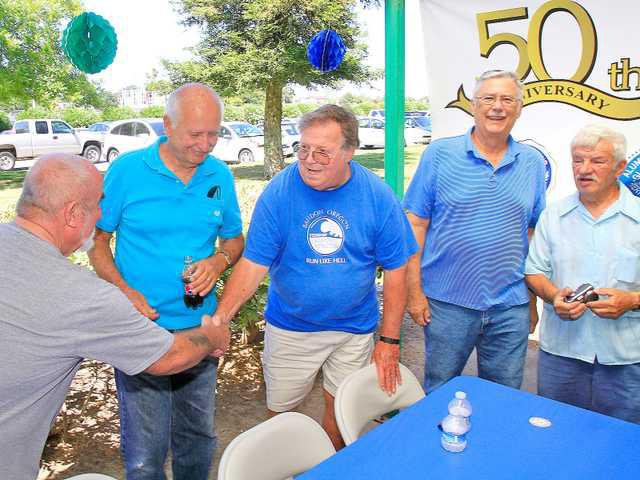
While a barbecue celebrating the plant’s 50th anniversary kept both current and former workers occupied outside, Salazar was able to point out the basic machinery used in the float glass manufacturing process – pioneered by the UK-based Pilkington corporation – and how it transforms from the basic elements of sand, soda ash and limestone into the windshield used in a family sedan.
“Basically the molten glass goes down a section atop a metal like tin, and because tin has a high specific gravity the glass will float to the surface,” Salazar said. “Eventually the glass will cool and the machines will pull the existing tin back down to recycle and you get sheets of glass.”
For Dennis Long, Thursday’s festivities might as well have been a celebration for his tenure at the Lathrop site.
A team leader in the section of the plant that oversees the packaging and shipping of the finishing product, Long began working at the Lathrop site in 1964 – just two years after it opened for operation. It makes him the longest tenured worker at the plant as well as one of only a handful of guys that can recall what those early days were like.
“I had somebody tell me that they were hiring so I just showed up here looking for work – I’ve been here ever since,” Long said before taking out a group on a tour. “I guess you have to have a job so I just stuck with what I had. It’s changed a lot – we’ve made an awful lot of products over the years.
“But the people that I’ve worked with are great. I really hope this place stays around for another 50 years. I know that I won’t be here, but hopefully it will be.”
Then there were the retired workers like Wendell Trenchick.
A native of Toledo, Ohio, Trenchick started working in the glass business in 1955. When a recession started to roll through the Midwest in 1961, he searched for other opportunities – learning that Libbey-Owens-Ford was going to be opening a new plant out in California.
So he packed everything up and moved to paradise for $2.65-an-hour – working at the plant in maintenance from the day that it opened until 1997.
“I learned that when you get your seniority you pretty much write your own ticket, and I liked not having a whole lot of people telling me what to do,” he said with a laugh. “I loved being here in California. I was two hours away from the snow and two hours away from the ocean.
“My idea of California before moving here was from what I saw on the Rose Bowl – all of these people walking around in shorts and T-shirts. It was my first time west of the Mississippi – took Route 66 all the way in.”
And an awful lot has changed since Trenchick punched his time card on the plant’s first day and Long was closer to 25 years on the job than he is to 50.
At one time the plant employed upwards of 1,300 workers to handle the laborious tasks associated with manufacturing sheets of glass at that time – a process which required hand grinding and polishing of both surfaces.
The invention of new methods coupled with technological advancements have cut that number down to just under 100 workers today.
Even though the decline in the workforce is something that United Steel Workers Local 418 President Jim Gulbronson doesn’t like to see, the 25-year veteran of the plant says that the company does what it can to try and keep guys on to operate the new machines if it’s possible.
“We’ve got a lot of good people that work here – a really strong group that’s a lot like a family,” said Gulbronson – a mechanic by trade. “The economy has hit us a little bit and a whole lot has changed in the last few decades – times are tough. But it’s a resilient group of people and hopefully those that are here today will be able to get to their retirement.”
Turning sand into glass for 50 years
Lathrops NSG/Pilkington marks golden anniversary