Manteca expects to reach a milestone of 80 city parks when three of the eight parks currently in the design phase are completed in 2027.
The new parks are “neighborhood” parks that are a far cry from the basic grass, backstop, playground, picnic table, water fountain and perhaps basketball court templates of the 1970s to 1990s.
The quote marks around the word neighborhood is due to the City of Manteca’s goal is to make every neighborhood park a destination park, and not just a park neighbors use.
To be clear, anyone can access a neighborhood park even though most since the mid-2000s are having their ongoing maintenance costs covered by community facilities district fees paid by homeowners within the subdivision they are placed.
What the city is doing is working with developers to make sure new neighborhood parks have amenities beyond the basic playground, picnic tables, baseball backstop, and storm retention basins that double as impromptu playing fields for sports.
The best example is the park being developed over the next two years as part of the 818-home neighborhood — including 672 apartments — Quarterra is building on the northeast quadrant of Atherton Drive and South Main Street.
It features a 2-acre open space area being developed and maintained as a park on Quaterra’s dime.
It will be accessible not just by apartment residents but by anyone in Manteca.
Even with that big of an initial and ongoing investment, Quaretrra will still pay the full $4 million park growth fees the development is assessed under city rules.
And it won’t be a run-of-the-mill “neighborhood park.”
It will include:
*A water play feature for kids.
*A cricket pitch.
*A pickleball court.
*Sand volleyball courts.
*Playground equipment.
*A dog park.
*Picnic tables with a shade cover.
*Walking paths.
*Lighting.
*Restrooms.
The restrooms is a big item for those who walk for exercise, especially the elderly.
Manteca stopped building restrooms in neighborhood parks in the 1980s due to ongoing maintenance costs.
But in recent years as walking around park perimeters has blossomed, the city has been receiving requests that restrooms be added to neighborhood parks.
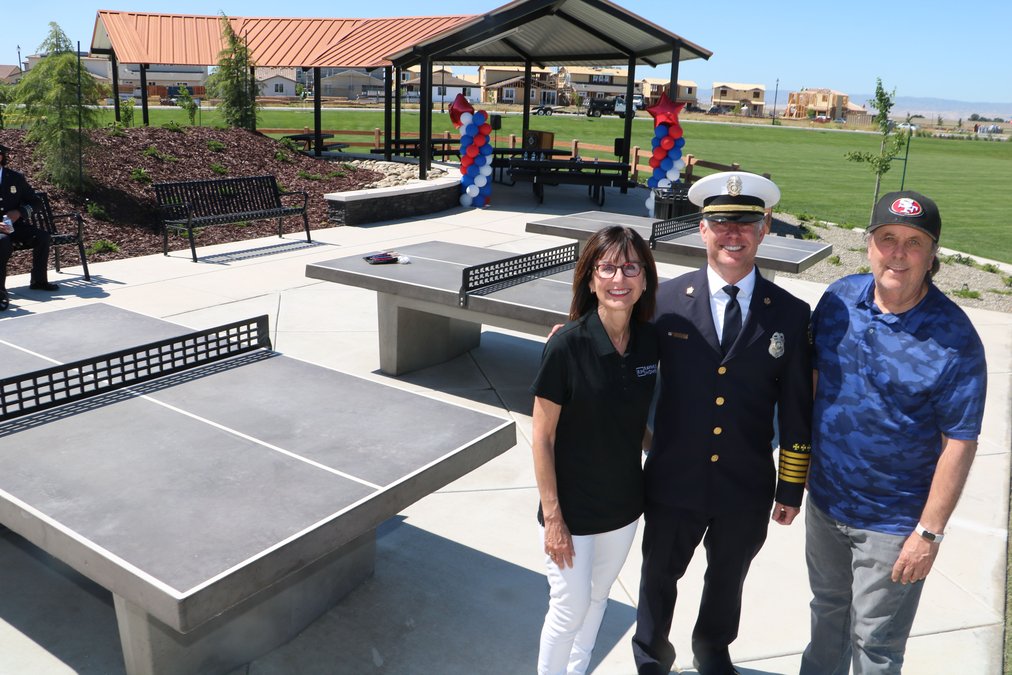
Raymus Homes helped the city break the neighborhood park mold with the development of Tom Moore Park in southwest Manteca.
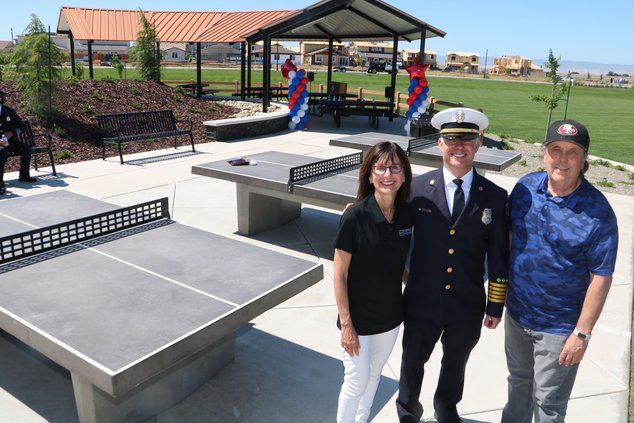
The variety of amenities at Tom Moore Park including three concrete table tennis tables, sand volleyball court, a compacted area designed for yoga and stretching, two cornhole courts, a concrete basketball court, a shade structure with picnic tables, and a backstop with an in-place partial fence.
A park in a neighboring development — the 827-home Lumina at Machado Ranch — also has features that break the same-old, same-old mold.
It features a 10-acre central park — the largest park yet in Manteca that isn’t a community park like the 50-acre Woodward Park.
Restrooms will also complement the park that will have an area for neighborhood and community gatherings including a picnic area designed for low-key “block parties” or even a small-scale farmers market.
For years, the city — except at community parks such as Woodward and Library parks — has refrained from building restrooms.
A city policy originally was put in place not to build restrooms at parks due to the cost of maintaining them. In later years, homeless sometimes became an issue.
The new parks, however, have all of their maintenance costs covered by community facilities district fees assessed on nearby homeowners. Council members said the city shouldn’t let “homeless” issues dictate the design of neighborhoods.
He added residents — especially the elderly and parents with young children — using parks want to have a restroom nearby if the need arises.
It is especially true of neighborhood parks where the city has included playing fields large enough for youth soccer team practices.
To contact Dennis Wyatt, email dwyatt@mantecabulletin.com