Manteca Unified in two weeks will start its 60th school year on Aug. 6.
It’s roots actually are a lot deeper going back 176 years ago to 1850 when French Camp — the oldest continuing school in the county that also includes land that was part of its original campus — was established.
In 1966, the voters of the feeder elementary districts for Manteca Union High School District — Manteca, Lathrop, French Camp, New Haven, Calla, and Nile Garden — voted to unify.
It was part of a statewide effort to reduce the number of fragmented school districts.
The pros were listed as reducing overall administration costs and increasing efficiency and resources by the state dangling increased per student funding for schools in communities that opted to unify.
There was a peak of 3,595 school districts statewide in 1931-1932.
By 1960, there were 1,636 school districts of which 1,316 were elementary districts, 201 high schools, 119 unified, and the rest defined by other measures.
In 1970 — four years after Manteca Unified — there were 1,144 districts.
Today there are 1,011 public school districts. That includes 345 unified districts, 515 elementary districts, 151 high school districts, and other specialized districts.
There were 11 schools when Manteca Unified in 1966-1967. They were Manteca High and East Union High plus Calla, Nile Garden, Sequoia, Shasta, Yosemite, Golden West, Lathrop, and New Haven elementary schools.
Today there are 29 schools — five comprehensive schools, 20 TK-8 schools, three alternative schools, and one adult school.
Other tidbits include:
*There were 275 K-12 teachers in 1966-1967 and 1,460 certificated employees (teachers librarians psychologists administrators) in 2025-2026.
*The average daily attendance was 7,013 in 1966-1967 and 23,673 in 2025-2026.
Manteca Unified is expected to reach almost 26,000 this schools year in peak enrollment.
Enrollment differs from attendance which basically means students are in class.
MUSD’s oldest school
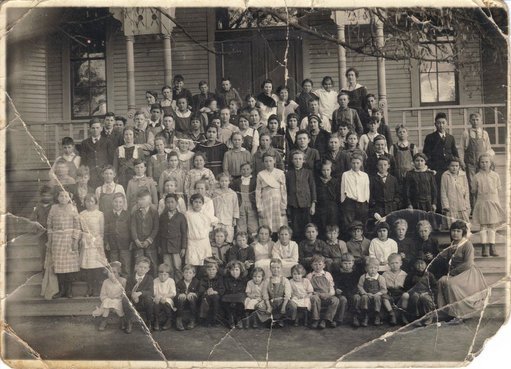
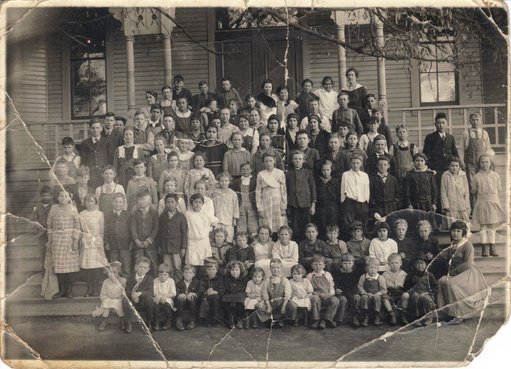
The oldest school in the Manteca Unified School District is French Camp.
It was founded in 1850 — four years before San Joaquin County Superintendent’s office divided the Castoria Township consisting of present-day Manteca, Lathrop, and French Camp into four districts.
The land where the original French Camp School was built a short distance north of the present campus was deeded to the school district in 1855 by Captain Charles Weber, four years after it was constructed.
It was a narrow, one-story clapboard-style building with a bell tower and a chimney designed to also serve as a town house and a public gathering place.
It cost $491 to build. Contrast that to $60 million to $70 million today to build a TK-8 school for roughly 1,400 students.
The first year the school was open for three months. It cost $900 to operate including $60 a month for the teacher’s salary.
Records sent by French Camp School in 1852 to the County Assessor, who doubled at the time as the Superintendent of Schools, indicated it was costing the county $24.55 a year to educate each student attending school.
There were 91 students registered but only eight attended on a typical day.
A second story was added several years later by the Sons of Temperance. The school then doubled as a church.
Initially, the student body was as diversified as you could get given the Gold Rush had brought tens of thousands of people to settle California and the fact French Camp had been the southern hub of a major trapping industry for 30 plus years.
Based on modern-day ethic classifications there were Asians, Blacks, Hispanics, Caucasians, and Native Americans students attending French Camp School right from the start.
A fire in the 1890s destroyed the original school. It was replaced with a new school a block to the south.
The second French Camp School had extensive Victorian gingerbread touches as was typical of the day
The third French Camp School was started in 1927. It featured brick walls and a tile roof. Parts of that school are still standing today.
Over the years children on the playground have found numerous artifacts dating back to the fur trappers.
In the 1950s, as an example, students found a large cache of bones on the northern end of the school yard. State experts examined them and determined they were elk and deer bones that had been broken into finger length segments.
The native Indians considered them delicacies and often sucked the marrow out before discarding the bone.
French Camp is also the oldest school in San Joaquin County that is still located on its original land.
The first area high school
Up until 1920, youth in Manteca, Lathrop, and French Camp going on to high school had to take a train each day to Stockton.
Since the turn of the 20th century there had been talk of established a high school to serve the area but discussions were dropped when it was determined the cost was too high.
Also creating a problem was where to locate the high school if it were built.
Lathrop argued it should be in their community since it was larger at the time than Manteca. Others argued for a location midway between Manteca and Lathrop.
Finally on May 20, 1920, voters approved forming a union high school district.
Nineteen men borrowed enough money on their own to pay Dan Baysinger to build temporary wooden buildings where Manteca High sits today.
It included two small classrooms, a study hall, office and library. The walls were covered with tar paper which did little to dampen sound. At the same time the roof leaked when it rained.
Three more rooms were added in 1921.
That was the same year when a $200,000 bond passed to allow construction of a more permanent campus featuring a California mission design including a tower.
The new school was dedicated on Jan. 27, 1923. More than 1,500 attended the all-day ceremony and toured the campus.
The doors were all solid oak, the floors were hardwood, and there was a 550-seat auditorium. The gym was on top of the stage measuring 76 feet in length. There was a net across the stage to keep flying basketballs out of the auditorium and people from falling into the orchestra pit.
Ten students were in the first graduating Class of 1923.
By 1968, the state determined the 45-year-old Manteca High buildings no longer met new earthquake standards.
The decision to tear down the tower sparked a community wide uproar. The Save Our Tower Committee was formed but to no avail.
The tower came down on Oct. 3, 1969. The initial efforts to topple it failed prompting the use of a wrecking ball.
To contact Dennis Wyatt, email dwyatt@mantecabulletin.com