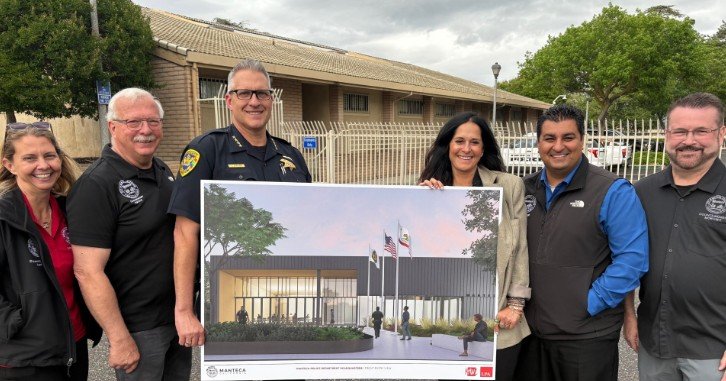
Drivers passing the new police station on South Main Street after it is completed in 2028 will notice extensive concrete flower beds in front of the $92 million building.
Some might dismiss it as eye candy that added to the price.
But don’t be fooled.
There are being placed there to significantly reduce the possibility of someone ramming the station.
It is one of many security design features in the new police headquarters expected to break ground in late August to mid-September that were unveiled Tuesday during an open house in the Civic Center council chambers unveiling of the 46,100 square-foot station.
The city is now positioned to go forward with replacing the existing 21,000 square foot station after two aborted attempts in the first decade of this century after civic leaders in 2001 declared it undersized with serious space deficiencies, and riddled with security issues.
After buying land first at 600 South Main Street to build a station from scratch where the new station will now go, the city purchased the 55,000 square-foot Qualex building at 555 Industrial Park Drive to refurbish for a police station.
Neither happened due to a lack of money.
Since then, space needs have worsened and aging infrastructure has created more problems.
What has also changed was passage of the three-quarter cent Measure Q sales tax in November 2024 that — when wedded with government facilities fees collected on growth — will allow for bonding to build the new station.
The security upgrades are numerous. And it is more than just bullet proof glass.
The station, as an example, will be secured behind an 8-foot concrete masonry with wrought iron railing on top.
It’s a significant upgrade from the current wrought iron fence with large gaps between bars where — in the past — people have been able to reach over the top to unlock gates.
That said, the city worked to keep costs down without sacrificing security and function.
One example is instead of a sally port — a secured area where suspects can be transferred to and from vehicles — there will be a sally court.
It will still have walls and doors that can be secured once a patrol unit is inside.
But by going sans roof — which would have required mandated and expensive exhaust systems to deal with vehicles — the cost was reduced significantly. Instead, it will have a canopy style roof.
There is also a 3,000 square-foot outbuilding designed for storage that isn’t mandated to be in a police structure designed to higher seismic standards due to it being a vital public safety building.
The outbuilding will also house two kennels as a respite for police dogs when their officer partner is busy handling paperwork and such inside the police station.
The end result is 3,000 square feet of needs will cost less than adding it to the 46,100 square-foot police station that is being built.
Community room doubles
emergency operations center
As you drive by on Main Street, the northern side of the façade will include a community room with a large glass wall adjacent to the lobby.
The space will do “triple” duty.
It will be available for community non-profits to use as well as for police outreach programs to address ways they can keep their families and neighborhoods safe.
It will also be wired for quick conversion to an emergency operations center.
That means instead of commandeering other space and temporary wiring it for a command center in an emergency, the public safety personnel can do a much quicker transformation of the community room.
The city had a makeshift emergency command center during the 1997 floods, the COVID-19 pandemic, and during PG&E public safety power shutdowns.
The layout is being done so the public doesn’t need to pass through secure areas when they ushered in from the lobby to conduct business.
An example is those who have to register as sex offenders. They can use a back entrance to access an area being put in place for such purposes.
There will also be touches such as a “soft interview room” where crime victims or children can be interviewed in a less intimidating setting complete with couches and chairs.
Using drones as the first
responders & trans officers
The station will have a real time crime center where an officer can access cameras across Manteca when a serious crime is reported. It will allow the police department to make a drone the first responder.
That will allow police to have eyes on a crime scene or a fleeing suspect while officers are responding.
It has been used successfully by other departments to basically zero in on where suspects have gone — over fences, behind building, and such. It has been proven to increase arrests as well as enhance the safety of officers and bystanders.
The new locker room reflects today’s realities.
Police Chief Stephen Schluer noted the department has no inkling on how many women may be officers on the force 20 years from now or if the need will arise to accommodate a transgender officer.
Instead of separate locker rooms, there will be one large area with rows of lockers. To the side will be a bank of changing rooms with sinks, showers, and toilets for individual officers to use.
There is also a fitness center as well as a separate mat room for officers to train on defensive tactics.
To contact Dennis Wyatt, email dwyatt@mantecabulletin.com