By JAMES BURNS
Special to the Bulletin
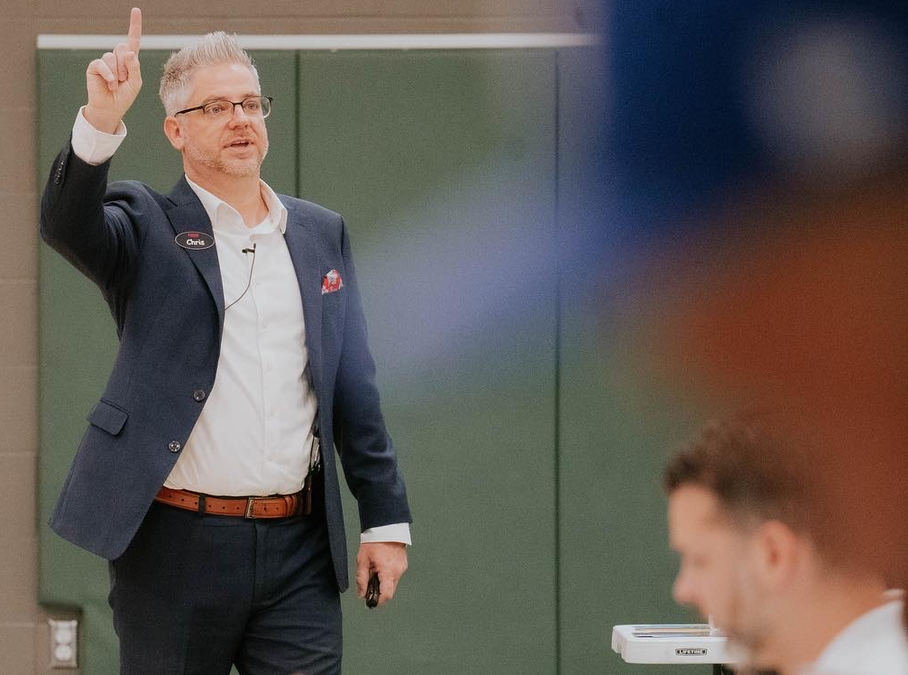
Chris Lowe has travelled the globe championing the Kagan Cooperative Learning method.
On Monday, the Kagan world tour stopped in Manteca with presentations simultaneously at Manteca Unified School District’s five secondary sites: East Union High School, Lathrop High School, Manteca High School, Sierra High School and Weston Ranch High School.
Teachers and administrators returned to campus for the first of two in-service days before the start of class on Thursday, Aug. 4, for 25,000 students.
At Manteca High School, Lowe, an educator for more than two decades and principal in New Jersey, spoke with approximately 80 certificated staff about the virtues of cooperative learning, as well as classroom and team building.
“Kagan training at MHS engaged teachers to empower all student learning at high levels,” said principal Frank Gonzalez, who, along with new assistant principal Megan Peterson, presided over the day-long event. “I am extremely proud of our staff and their commitment to build their teaching skills through collaboration.
The Kagan Cooperative Learning method was born from a research program developed by Dr. Spencer Kagan in 1968, and it focused on placing students in situations that fostered engagement and participation. The structures that Kagan introduced into education “not only led to greater cooperativeness, but led also to greater academic achievement, improved ethnic relations, enhanced self-esteem, harmonious classroom climate, and a range of social skills,” according to material provided by Kagan.
East Union assistant principal Andrew Lee believes the methodology will help improve the learning environment at the North Union Road campus, where the Lancers begin a new era under principal Eric Simoni. East Union’s presentation was delivered by Kim Rostick, who is only a year removed from the classroom. That fact, Simoni said, helped make for an engaging and entertaining training session.
“Kagan training and supporting materials feels like a classroom game-changer,” Lee said. “The strategies of cooperative learning are dynamic with integrated socio-emotional learning components. It incorporates student movement, classroom management, individual accountability, and rigor. Quite simply, these methods are highly engaging.
“When implemented, the structures create a learning environment for students to thrive. I am convinced that this pedagogy can elevate the student learning experience for ALL learning styles, behaviors, academic abilities, and other relevant backgrounds. No more students slipping through the cracks.”
Structures include engagement tools like mix-pair-share, “RoundRobin” and “RallyRobin,” and timed pair-share.
Lowe, who comes from a long line of educators, has played a big part in spreading the methodology to places near and far.
The pages of his passport have been stamped with his summer travels with Kagan Publishing and Professional Development. He spent 10 years in South Korea, worked with students in China and the United Arab Emirates, and domestically, he’s touched student and teacher lives in California, Wisconsin, Florida, New York, Illinois and Texas, among others.
When Lowe steps to the dais, he speaks from experience. Eleven years ago, the Kagan Cooperative Learning method helped him transition from a self-described English teacher with a great lesson plan and a knack for entertainment to a teacher with a great lesson plan and knack for entertainment who could also foster genuine engagement.
The impact in his classroom, he says, was almost immediate.
“Literally, in three weeks, they were all using their English (concepts) and talking about the content and building relationships,” Lowe said. “I’ve never seen a method of teaching that gets every single kid actively participating in every lesson. I’ve never seen anything like it.”
James Burns is a Communications and English teacher at Manteca High School. He spent more than 20 years in sports journalism, working at publications across Northern California’s Central Valley.