MARKLEEVILLE — To some, it’s the ultimate cycling challenge — the Tour of the California Alps.
It has the aptly named moniker as “The Death Ride”. It features 14,000 feet of climbing in 103 miles of quad busting spread between sustained rides up both sides of three passes.
It is, without a doubt, the biggest event in Alpine County.
The 3,500 riders alone for the annual summer “fun ride” almost triples Alpine County’s population.
You read that right.
Based on the 2020 Census Alpine County has 1,204 residents.
It comes in dead last among California’s 58 counties for population.
Toss in the fact it is 50th in land mass with 783.33 square miles — roughly half the size of San Joaquin County — and you get the idea that you can really enjoy the wilderness.
The Death Ride — or should I say the desire to do the route but not compete in the actual event — is what first lured me to Alpine County in 1988.
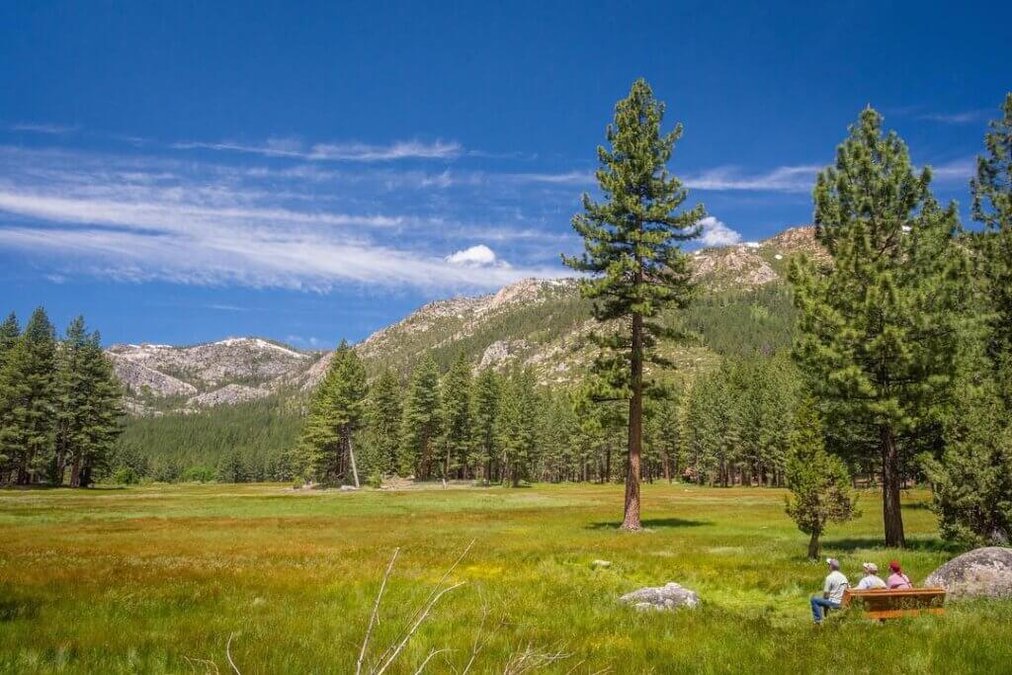
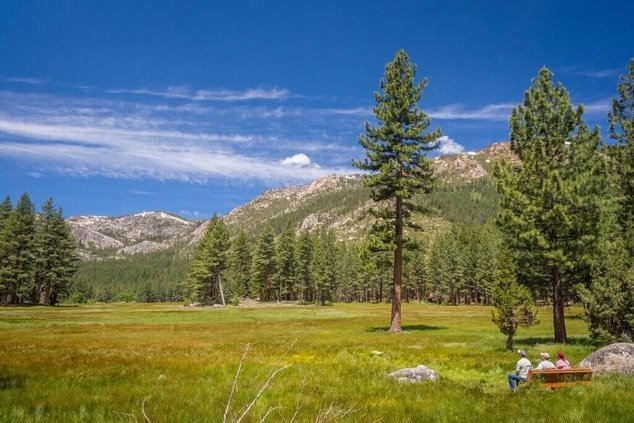
It is where I discovered the enchantment of Hope Valley — it’s one of the largest alpine valleys in all of California and has been protected from further development — by booking a stay at Sorenson’s Resort that’s now known as Desolation Hotel.
Alpine County boosters like to describe their piece of heaven as the Switzerland of California. The folks out of June Lake in Mono County may disagree, but Alpine County is worthy of that moniker.
There are other worthy resorts in Alpine County plus camping options galore, but I’ll focus on Desolation Hotel in Hope Valley as a prime example of why taking a less than three hour drive from Manteca using Highway 88 out of Stockton and spending a few days there is good for the soul.
And if for no other reason if you are end up having urban glitter withdrawal, the hustle and bustle of South Lake Tahoe and the Stateline casinos and shows are less than 30 minutes away from Hope Valley.
Yet thanks to what is between the resort at Highways 88 and 89 and the craziness South Lake Tahoe traffic can be at times, it seems light years away.
It is why even if you aren’t into accessing solitude, fishing, cycling, rafting, or hiking all over creation staying in Alpine County at Desolation Hotel, other resorts or various campgrounds its will worth getting away from enjoying the faster paced — and substantially more crowded — Tahoe Basin to recharge.
Desolation Hotel Hope Valley is an all-season resort and for good reason. You can stay there each season and get an entirely different experience. It runs the gamut from winter wonderland while staying in cozy cabins to blankets of wildflowers in the summer and New England like aspen colors in the fall.
The 165-acre resort at 7,300 feet offers hiking, fishing, snowshoeing, skiing, history and geology tours, watercolor and photography workshops and many more programs to choose from, or relax and unwind in a hammock.
Keep that hammock in mind. I like to read a good book — either about water development or California history — when I’m on vacation. Hands down the best place I’ve enjoyed book reading is in a hammock outside my cabin in Hope Valley. It is borderline decadent with gentle breezes, the shade, the scenery, the alpine smells, and the virtual quiet.
It offers one to two person cabins from $229 a night. There are also other options such as cozy cottages, larger cabins as well as bed and breakfast and luxury yurts.
All of it is situated along the West Fork Carson River meandering through high-mountain meadows that flow seamlessly into pine and aspen forests.
Samples of the amenities include a full-service restaurant, a wood-fired sauna, and even accommodations for events.
Admittedly, if you’re not a cyclist bonkers for climbing or pedaling your way past scenery that literally can be breath taking, there are tons of other reasons to make your way to Alpine County.
Hiking and fishing are on the list as is cross-country skiing and such.
Alpine County on its western flank includes two of the four ski resorts in the 209 — Bear Valley on Highway 88 and Kirkwood on Highway 89.
It is also home to Grover Hot Springs State Park.
The pool complex is fed by six hot springs.
Grover Hot Springs State Park requires an $8 vehicle day-use fee, with pool admission costing $10 per adult and $5 per child (16 and under). Pool access is managed in 90-minute sessions on Friday, Saturday, and Sunday, and pre-booking is advised
The park also offers day use for hikers and picnicking plus there are campgrounds.
Just over 96 percent of the county is in public ownership. It is why the county hasn’t grown much from its 1970 population of 424 residents.
Alpine County is not the place for you if you can’t stand being far away from Starbucks or a favorite chain restaurant.
The county has no traffic light, bank, movie theater, dentist, or supermarket.
Most of the county’s income is derived from visitors from the booming tourism communities of Lake Tahoe and western Nevada, who seek out Aline County for its rich outdoor recreation.
The “big” town is Markleeville where you will find four restaurant and a general store. Surprisingly, two of them — Stonefly as well as the Cutthroat Brewing Company — are a notch above the hearty cafes you’d expect in the high Sierra.
Cutthroat Brewing Company per se closed in 2024 but was brought back to life in 2025 by local Alpine residents as Cutthroat
One of the best times I’ve had at the Cutthroat Brewing Company catching up with old friends and former cycling companions who had traveled to the area from Idaho and Southern California. I had ridden the Death Ride route with them years ago.
While they were staying there, I drove up from Manteca after making a quick side hike from of Sonora Pass to the highest point in Alpine County — my go to summit for a quick climb of Sonora Peak at 11,404-feet.
It actually straddles the boundaries of Alpine and Mono counties.
Now for a bit of history.
The first to enjoy the offerings of what is today Alpine County were the native Washo people.
The Washo spent their summers around the shores of Lake Tahoe.
The earliest Americans were a who’s who list of California explorers — Jedediah Smith, Joseph Walker, John Fremont and Kit Carson.
Fremont and Carson — for whom Carson Pass on Highway 4 is named in 1844 — made a mid-winter trip across the Sierra Nevada in opening up travel routes across the range that pass through today’s Alpine County.
They were followed in 1848 by members of the Mormon Battalion and a year later by the Gold Rush ’49ers.
What is today Highway 88 — the Carson Route of the California Emigrant Road — was the favored route to reach the gold diggings.
It was silver, not gold, that lured the first settlers to Alpine County.
After silver was found in what was to become the fabulous Comstock Lode near Virginia City in 1859, thousands of prospectors swarmed into the eastern Sierra seeking riches.
And if Alpine’s charm and quietness gets to you, South Lake Tahoe and casino bustling Stateline, Nevada, is an easy 25 mile drive.
To find out more about Alpine County and what it has to offer in terms of recreation and such, go to alpinecounty.com for information provided by the Alpine County Chamber of Commerce.
To contact Dennis Wyatt, email dwyatt@mantecabulletin.comn