South San Joaquin Irrigation District — by virtually every measure — has a successful history of protecting and developing water rights secured 117 years ago.
It is a constant battle to do so in California where water wars are as old as the state itself.
But that isn’t the big worry today for SSJID.
It’s reliability.
Without making sure the diversion, storage, and distribution system is as bullet-proof as possible, it increases the chances an incident — rockslides, pipe failure, and even prolonged power outages — can cut off water.
It is water that 215,000 people in Manteca, Lathrop, and Tracy expects will flow from their tap when they turn it on for household needs or from hydrants to fight fires.
It is water critical for 50,000 acres of farmland that, if the system suffers a disruption at the wrong time such as the peak of the growing season when 100 degree temperatures are common, there would be major crop losses.
The SSJID board has taken the need to minimize the odds of either scenario happening through the pursuit of a $192 million overall water facility improvement plan designed to strengthen resilience and reliability.
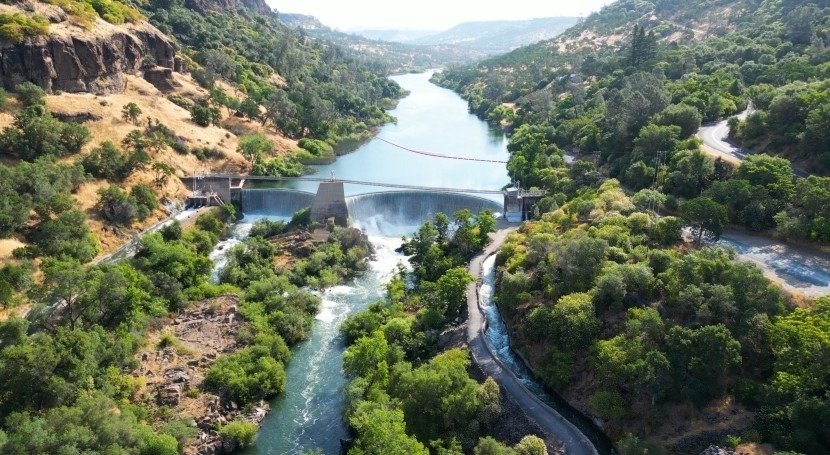
It addresses those concerns from the point water is diverted at Goodwin Dam on the Stanislaus to where irrigation water is delivered to individuals farms and treated water to city water systems.
Canyon tunnel project
Arguably the most critical is the $94 million canyon tunnel project now underway with a targeted completion of 2028.
It takes the main supply canal — and only physical way to divert water from the Stanislaus River watershed to eventually reach the 215,000 people as well as upwards of 1,000 farms relying on the SSJID — and buries it 200 to 300 feet underground.
In doing so, it accomplishes two major things:
*It eliminates the real threat that perennially occurring rockslides that block the current canal and tunnel system and damage canal sections could create a long-term disruption of water reaching the SSJID distribution system.
*Even with SSJID picking up $68 million of the tab (Oakdale Irrigation District is paying $26 million for the proportional share of its water that flows through the canal), it will end up costing the district less money in annual repair and maintenance work as the decades unfold.
“It (the loss of the ability to divert water) would have serious consequences for urban and farm users,” SSJID General Manager Peter Rietkerk said during a presentation to the Manteca Rotary Club on Thursday.
The new 12,106-foot long and 18- to 20-foot tunnel will replace a series of 13 tunnels as well as segments of open canals.
It will accommodate the flow of 1,263 cubic feet of water per second — the equivalent volume of 1,263 basketballs filled with water passing a specific point in a second.
Woodward Reservoir
spillway & water quality
Two separate endeavors are in the works for the SSJID’s 33,000 acre foot capacity Woodward Reservoir.
It is the only in-district reservoir and is positioned to allow gravity flow to the far southwestern reaches of the 117 square miles of SSJID service territory.
Water does not flow from the Stanislaus River for six months when Oct. 1 rolls around each year.
What is stored behind Woodward Reservoir as of Oct. 1 is all the SSJID has to supply treated water to the cities through winter and if an early irrigation run is needed due to drought conditions.
The reservoir — that was built in 1916 — does not currently have a spillway.
The state Division of Dam Safety in the aftermath of Oroville Dam’s near failure in 2017, is now requiring a spillway at Woodward that would spill water, if needed, without human intervention.
The district is now in the design phase of that project.
It could potentially allow SSJID to operate the reservoir at the maximum of 210 feet instead of the current 205 feet to allow for the capture of winter rain.
As such, it could increase storage capacity or at least negate silt buildup from over the last 110 years.
The other Woodward Reservoir project is taking over control of the recreation facilities that had been contracted to Stanislaus County Parks & Recreation for years.
While the SSJID would still secure a concessionaire, by ending their relationship with Stanislaus County it will provide funds to significantly upgrade recreation facilities and create another revenue stream for the district.
Currently, Stanislaus County counts on the revenue they receive from the Woodward Reservoir contract to fund more than 40 percent of their countywide parks and recreation budget while they have not been upgrading facilities at the reservoir.
The move also gives SSJID tighter control in protocols aimed at keeping the invasive golden mussels out of the reservoir.
The mussels pose a threat to water diversion systems by reducing their capacity and even the effectiveness of filters.
Drinking water &
the treatment plant
The Nick DeGroot Water Treatment Plant to the west of Woodward Reservoir on Dodds Road started delivering drinking water to Manteca, Tracy, and Lathrop in 2005.
It was never intended to be the primary source of water for the three cities but growth and changing groundwater rules have made the treatment plant more critical to 215,000 people.
Backup generators — a $2.2 million project — will allow the plant to keep treating water for extended power outages that have become a real concern with grid reliability issues as well as PG&E public safety power shutdowns during heightened wildfire conditions.
The generators — ordered in May 2024 —- are expected to be delivered and installed this summer.
The district is also in the process of updating the treatment plant’s massive solar farm to continue to reduce the need for PG&E electricity and keep costs down.
That is in addition to starting initial work on the need to expand the treatment plant capacity to support continued growth in Manteca, Tracy, and Lathrop.
Other improvements
In addition to routine maintenance, the $192 million water masterplan includes capital improvement projects throughout the rest of the SSJID system.
It touches everything from nearby 400 miles of canal to the 40 million gallons capacity water treatment plant.
The district has a $46 million annual operating budget and 108 employees.
It is also partners with OID not only in protecting pre-1914 water rights to 600,000 acre feet of water on the Stanislaus River watershed the two districts secured together, but also the Tri-Dam Project that harnesses that water.
Tri-Dam owns and operates three reservoirs — Donnells, Beardsley, and Tulloch.
It also includes hydroelectric plants that generate 125 megawatts of electricity.
To contract Dennis Wyatt, email dwyatt@mantecabulletin.com