Manteca is now closer to the point where traffic signals controllers can “talk” to each other to maximize traffic flow based on current conditions.
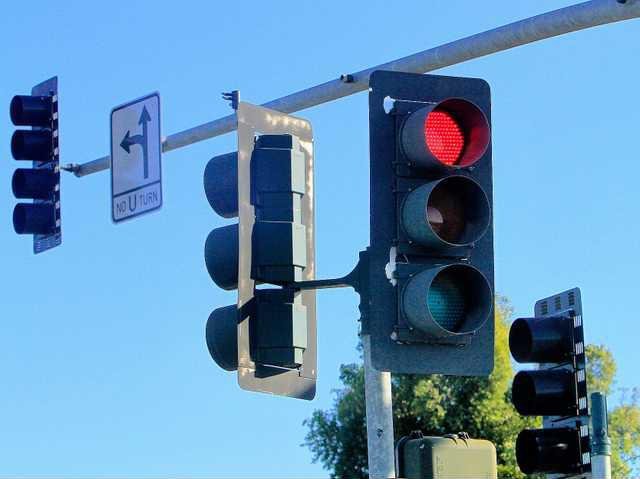
The City Council Tuesday approved the final payment for a $4.18 million traffic signal update project conducted by St. Francis Electric.
The cost was covered by a $3 million federal Highway Safety Improvement Program grant plus funding from the city’s share of state road funds.
The work included upgrading existing traffic signal hardware and software, including, but not limited to, traffic signal cabinets, traffic signal controllers, 14 battery backup systems, signal heads with yellow retroreflective borders, preemption systems, signal timing optimization, and the development of interconnect functionality via fiber optics at 47 intersections.
Besides upgrading signal hardware and such, the work sets the stage for the day when Manteca will be able to have real time modifications in timing that typically only significantly larger cities enjoy.
Assistant City Manager Kevin Jorgenson said eventually the software in place will allow the identification of traffic congestion issues and make signal timing adjustments in real time.
Given the high cost of getting to that point, the city is phasing in the infrastructure.
Jorgenson noted advances in artificial intelligence will one day allow Manteca to minimize traffic delays and maximize traffic flow
Real-time traffic signal adjustment relies on or Adaptive Signal Control Technology (ASCT), which dynamically changes red, yellow, and green light timings based on live road conditions rather than a rigid time-of-day schedule.
According to the federal Department of Transportation:
*Systems use pavement inductive loops, video cameras, radar, or connected-vehicle data to measure vehicle counts, queue lengths, and pedestrian presence second-by-second.
*Central or decentralized software employing algorithms and artificial intelligence processes the incoming data to calculate optimal cycle lengths, green time per direction, and coordination between neighboring lights.
*Instead of isolated timing, signals talk to each other to create a "green wave," allowing platoons of cars to move smoothly through multiple consecutive intersections.
Noted key benefits & drawbacks:
*Cuts average travel times and delays by 15% to 40%.
*Lowers idle time, reducing fuel consumption and greenhouse gas emissions by 10% to 20%.
*Can prioritize public transit buses, emergency vehicles, or heavy rush-hour directions on the fly.
*Requires high initial equipment and software costs, reliable communication networks, and ongoing technical maintenance.
There is not a time table yet as to when the upgraded system can start making modifications in real time.
To contact Dennis Wyatt, email dwyatt@mantecabulletin.com