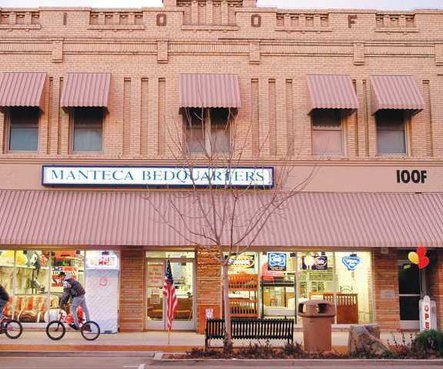

As we were driving down Main Street Monday talking about things in general including people who commute to the Bay Area for bigger paychecks, Ashley turned to me and said the obvious, “Papa, the people who can afford the nice new houses here don’t work in Manteca then?”
Nothing earth shattering about that statement except for one little thing: It was being said by my 24-year-old granddaughter who just realized the jobs being created in Manteca for the most part won’t get you enough to even afford the bonus room option on most new homes.
It is clear to Ashley the American Dream as touted by politicians and pundits doesn’t exist for the vast majority of young Mantecans. They’re the ones struggling to compete against others to break out of $10 an hour jobs to start climbing the proverbial economic ladder.
Most of us 40 or older can’t resist arguing that all people have to do today to improve their lot in life is be willing to work at minimum wage jobs and work their way up like we did. But we didn’t have to deal with employers struggling to keep costs down that take advantage of the surplus of labor to hire platoon workers to avoid everything from healthcare costs to the possibility of having to foot the bill for family leave.
Those 40-hour a week minimum wage jobs we used to launch us on the road to being able to financially support ourselves are now chopped into 20-hour or less part-time gigs.
Young adults like Ashley are making a go of it by renting rooms, staying with parents or grandparents, finding two to four others in the same situation to split the cost of an apartment or kissing Manteca good-bye.
Some will argue Manteca is no different than Peoria where employers also face the same challenges of healthcare and the changing retail/service world in the Age of the Internet. But there is one big difference: The cost of living.
RentJungle.com puts the average price of all one bedroom apartments at $609 a month in Peoria and $989 a month in Manteca. The average price of a home sold in Peoria is $120,000 versus $359,000 in Manteca.
It’s bad enough that housing is higher in Manteca given that it is the biggest chunk of a household’s expenses. But because housing is higher, it makes everything else higher. Then there is the added joy of California living: More expensive gas. More government which means more taxes. Environmental standards that protect the Golden State’s natural resources that adds to the cost of doing business as well as living.
Manteca — and nearby communities such as Lathrop, Tracy, and Stockton — are clearly the emerging top option for affordable housing for people being squeezed out of the Bay Area. Try to rent an apartment in San Jose as a single person making $70,000 or buy a home in Santa Clara making $160,000 a year.
The reason 20-Somethings and people older or even young families, single moms, or the elderly on limited income are still in Manteca has a lot to do in the wholesale abandonment of the aberration that followed World War II. Simply put, single family housing in a growing number of instances no longer houses a single family. As many as a quarter of the homes in many Manteca neighborhoods no longer function as single family homes. Some of the reasons are cultural, most are financial.
It is not necessarily a bad trend given it puts less pressure on resources as well as lifts the economic well-being of all who are living under the same roof.
Which brings us to who can afford those “nice new houses” Ashley was talking about.
The Raymus siblings — Toni and Bob — as well as the Manteca Development Group folks consisting of Bill Folios, Mike Atherton et al are making a conscious effort to build some new homes affordable for Manteca residents. But let’s make it clear. Many hold jobs in the Bay Area and those that don’t and are indeed employed locally are teachers and other professionals. In short, the local buyer pool they serve outside of move-up buyers constitute a fairly small portion of the in-Manteca workforce.
The vast majority of new homes being sold are to newcomers to Manteca. And almost all of them are being squeezed out of the Bay Area.
They also have expectations about community amenities that parallel the amenities that many existing residents believe growth should bring to Manteca.
For that to happen, Manteca’s elected leaders must make putting in place growth fees for things such as new libraries and other amenities the absolute top priority. They also need to make sure fees being collected are adequate. Growth can never pay more than its legal share. Growth, however, hasn’t been paying its fair share mainly due to wishy washy council directives and the inability of city staff to clear the time and commit the resources to fast track fees and the need to keep them updated.
Mayor Steve DeBrum during this year’s budget workshop hit the nail on the head when he said every house that is built is leaving money on the table.
The Ashleys of Manteca aren’t benefitting from political decisions to not tack growth fees for amenities such as a library system onto the cost of a permit to build a new home.
It’s a fantasy that organizations like the Building Industry Association of the Delta like to perpetuate to pad the bottom line of its members.
This column is the opinion of executive editor, Dennis Wyatt, and does not necessarily represent the opinion of The Bulletin or Morris Newspaper Corp. of CA. He can be contacted at dwyatt@mantecabulletin.com or 209.249.3519.