The just completed first phase of the Highway 99/120 Bypass Connector Project has the ability to change and save lives.
Just ask Ripon City Council member Leo Zuber and San Joaquin. County Supervisor Robert Rickman.
First the ability to change lives.
Even though the $50 million project that added a second transition lane from the eastbound Bypass to southbound Highway 99 and widened the Austin Road interchange is four miles north of Ripon, it will address serious traffic issues in the community of 16,013.
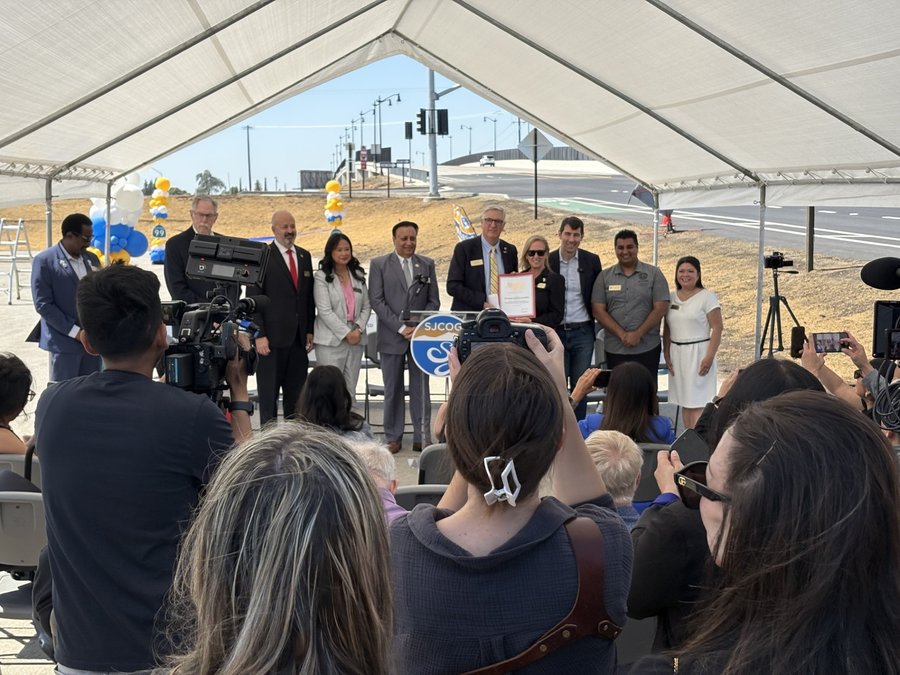
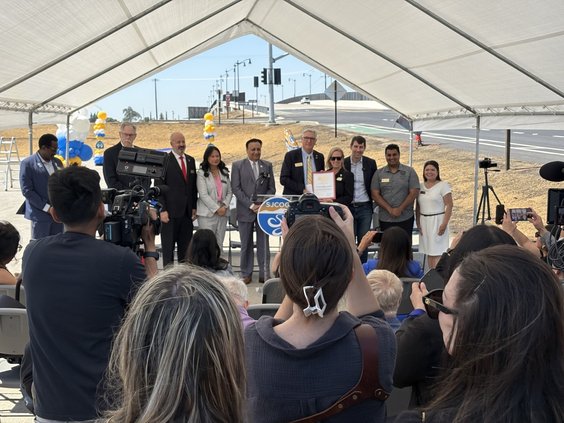
“I’ll be able to go from home to the grocery store at 2 p.m. in the afternoon in less than 20 minutes,” Zuber told those gathered Wednesday morning for the official ribbon cutting of the San Joaquin Council of Governments project.
Zuber was referencing the afternoon phenomenon of backups on key community streets that he indicated could reach a mile or more of commuters sent into Ripon via backroads by apps aimed at getting drivers around the habitual stop-and-go quasi parking lot the eastbound Bypass was in the afternoon.
It is ditto as well for southwest Manteca neighborhoods.
Drivers headed toward Modesto and points south in backed up traffic — even when there wasn’t a predictable accident happening every 2.5 days on average to jam up the flow — would exit the Bypass at Union Road or Airport Way.
They would then head toward Atherton Drive to Woodward Avenue and try to get on Highway 99 just past the transition.
Half mile and longer backups were typical between Woodward and Moffat from traffic that was inching through the four-way stop at Moffat and Austin that was just ahead on the on-ramp.
The fix — which required replacing the 1955-era two-lane Austin Road overcrossing to accommodate additional and longer transition lanes on Highway 99 — eliminated the stop sign.
That’s because Austin Road now also bridges the Union Pacific Railroad tracks giving Manteca its first grade separation along the tracks that slice the city in two.
The project also included realigning and widening Woodward to four lanes between Atherton and Moffat plus traffic signals installed at Atherton and Woodward as well as Woodward and Moffat.
It also includes a new connector street from Austin to Woodward.
The two-lane road named Singh Street by SJCOG in a nod to the growing Punjabi American population in Manteca — Singh, which means lion, that is used extensively as a first, middle, or surname — also has traffic signals where it intersects with Austin.
Now for the ability to save lives.
When Rickman was working as a CHP officer, he was assigned the South County beat in 2000-2001 that includes the Highway 99/120 Bypass interchange.
“Almost every morning at around 5:30 near the end of my shift, I’d get dispatched to an accident on the Bypass (near the interchange),” Rickman said.
Congressman Josh Harder, who helped secure $5 million in federal dollars for the project, noted that the segment of freeway had become the worst crash-prone in California.
“All of that changes today,” Harder said, thanks to the second transition lane being opened from the eastbound Bypass to the southbound 99.
Harder pointed the project also means “cleaner air, improved commutes, and safer streets” as well as having been completed within budget.
The Caltrans environmental report justifying the project noted the mile of freeway segment involved had a 6.5 times higher accident rate than the state average.
At one point, Manteca Fire was responding to an injury and/or fatality accident every 2.5 days.
If you toss in fender benders not requiring an ambulance or fire response, the accident rate was almost one a day.
Driving prosperity
Manteca Mayor Gary Singh noted the project — and the second phase yet to be funded — will help strengthen the regional economy as well as improve the quality of life of commuters.
Fixing the chokepoint was a priority for cities throughout the region as it adds considerable time not just to the commute for many of their residents but also for the movement of goods.
That was underscored in the 2 minutes give or take that Singh was addressing the gathering of nearly 100 people in the former park-and-ride lot at the intersection of Austin Road and the 99 Frontage Road at the foot of the new interchange.
As he spoke, no less than 50 semi-trucks passed by in the background on Highway 99.
And the need for the second phase that would add a second transition lane from northbound 99 to the westbound Bypass, was re-enforced by a slowdown of freeway traffic to less than 30 mph due to backups through the transition point.
Manteca invested $3.5 million to cover the cost of the replacement interchange — complete with Tidewater-style street light fixtures — so it could be four lanes instead of two lanes.
It was the result of a Manteca council decision to plan for future growth given the state — that contributed $32 million — does not pay for interchange work that is designed to handle growth.
The balance was secured by SJCOG.
The project was the first the regional agency has overseen from start to finish. Their decision to do so allowed the project to move forward sooner than later.
The next phase
The overall project was originally envisioned as a three-phase endeavor.
That went out the window when Union Pacific declined a request to allow additional support columns placed in their right-of-way as it would impede their ability to double track the line on the future.
SJGOG re-engineered the design, eliminating elaborate and extended braided ramps to exit southbound — and join the freeway northbound — at Austin Road.
SCJOG is now seeking funding for the second — and what will be the final phase — to replace the two ramps, add the second 99-to-Bypass transition lane, and effectively widen the Bypass to six lanes all the way from 99 to Airport Way.
The replacement ramps at Austin Road will now both loop and go under the freeway.
The re-engineered project will also be tens of millions of dollars less to build.
To contact Dennis Wyatt, email dwyatt@mantecabulletin.com