
The numbers, at first glance, seem staggering.
Manteca Police between April 28, 2025 and May 28, 2026 have issued 17,139 tickets for red light running at five intersections.
That’s 17,139 violations in 486 days for an average of more than 37 on any given day.
Then you talk to Manteca Police officers.
You the find out the threshold had been loosened for “rolling” right turn red light running, allowing those that never quite come to a complete stop but aren’t doing so at a speed judged to be as dangerous to not get cited.
Apparently, if it wasn’t for that, the red light citations issued would be significantly higher.
Those officers that have been assigned to the Manteca Police traffic unit over the years are not surprised about the numbers.
They see people day in and day out running red lights.
But given issues associated with their positions where they observed infractions, weighing the dangers of pursuit — whether it is traffic flow such as vehicles crossing their paths given they have to give chase by against the light — and overall public safety, there weren’t many tickets issued.
When they do go after a red light runner it can easily tie up 10 to 15 minutes.
Many times, it’s likely a given drivers when they are caught silently seethe — or complain later to whoever will listen — how unfair it was they got a ticket because everyone else does it.
That means the latest red light camera technology — that meets the exacting standards imposed by the legislation and California courts to make sure a citation is “righteous” — is the great equalizer.
Everyone that breaks the red light law at the intersections gets the ticket they deserve.
And given the police aren’t hardcore on the right turn, they are clearly upholding the spirit of the law and not the absolute letter, they are issuing citations in a reasonable manner.
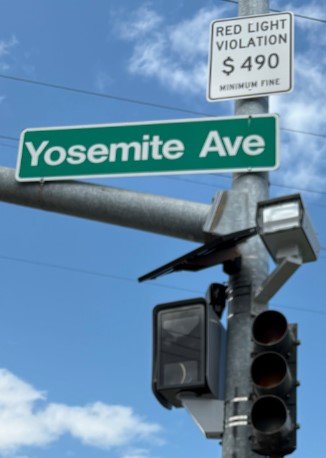
When the cameras were installed last year, state law allowed for a $490 fine and — more importantly — a moving violation point on a driver’s DMV record.
Get enough points in a set period of time and auto insurers, rightfully so, will often increase premiums due to the risky driving habits the DMV points represent.
Months after the Manteca red light camera system was up and running, the state legislature lowered the penalty for a red light camera violation — although not one written by an officer on the street, to an infraction maxed out at $100.
That means no point concerns on DMV driving records.
The citation for the $490 ticket goes to the driver, the citation for the $100 infraction goes to the registered owner of the vehicle that runs a red light.
The fine is also handled by local jurisdictions like a parking ticket, which means it doesn’t involve the court system.
Those with existing systems under contract were given the option of opting in to the $100 in fraction route.
Because of that, switching from the moving violation costing $490 to the infraction costing $100 will actually send more money Manteca’s way.
The money the city gets from the $490 ticket is less than $100 after the state and courts take their cut.
The $100 infractions all go to the city.
Of course, most of the money Manteca receives will go toward paying for what are essentially 18 more “traffic cops” in the form of red light cameras American Traffic Systems installed at selected intersection approaches and forwards video and radar evidence to the police for a final decision on whether a driver is cited.
Money left over from the red light violations beyond what goes to fulfill the contract can be used by the city for traffic safety improvements on Manteca streets.
It should be noted, in a given year of the red light fines don’t generate enough money to cover the contract, ATS has to write off the difference. California law forbids cities from having out any money to cover red light camera contracts.
The entire idea of red light cameras is to improve safety by making drivers that do pay the consequences.
The reason for the legislature changing the rules is the contention there were too many low income drivers getting cited statewide.
The $490 ticket was considered too burdensome. That conveniently forgets the fact the courts already had the ability to knock the fine down to $100 for those that could proof they met the low-income criteria.
For those that aren’t low income by a long shot, the bigger stick is the potential to see insurance premiums skyrocket.
City staff is expected to bring the opt-in option for the $100 infraction to the council for consideration.
It would seem the bigger hammer, assuming it is to get people to stop wantonly violating red light laws that constitute a large chunk of more serious and costly collisions on city streets, would be retaining the $490 fine.