Mother Nature is flirting with 100 degrees and there is not a rain cloud in the sky.
Yet rainwater is threatening Manteca’s growth engine — housing development.
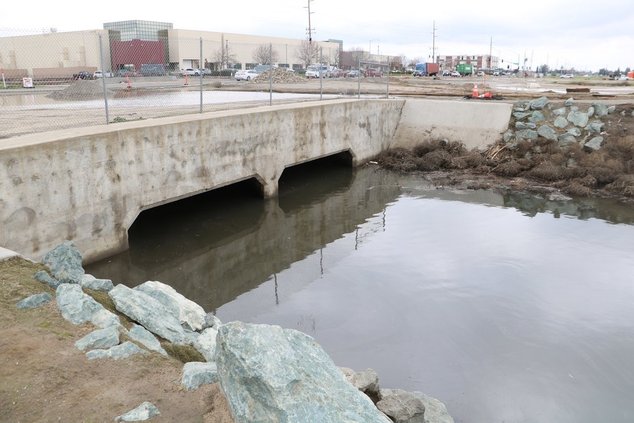
It’s because the French Camp Outlet that South San Joaquin Irrigation District put in place over 110 years ago is nearing capacity.
And when it does reach that point in terms of hydrology models that calculate runoff from storms, rest assured the current SSJID board won’t continue approving Manteca development that needs to drain storm water into the outlet and out to the San Joaquin River.
You read that right.
The SSJID effectivley needs to approve all Manteca development that drains into the outlet. And to do so without increasing its capacity would clearly open the district to liability exposure if flooding occurs because the outlet — coupled with the city’s extensive storm retention basins — can’t contain the water.
Most of Manteca has — and is — being built on farmland served by SSJID irrigation ditches.
Over the years as growth has occurred, the ditches have been replaced with buried pipe.
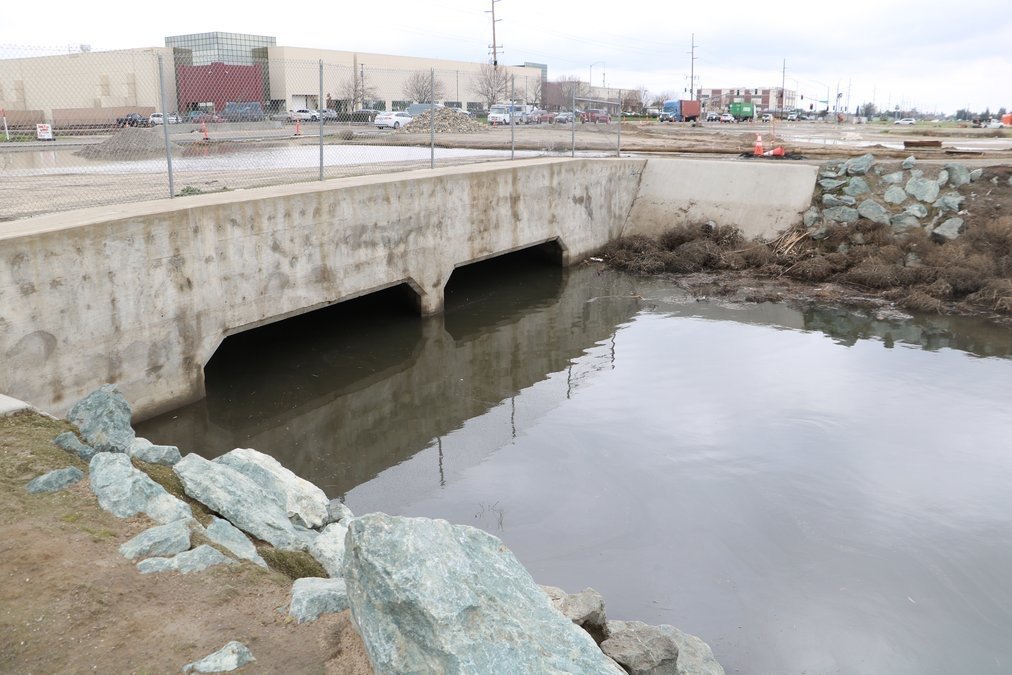
The French Camp Outlet along the railroad tracks separating Manteca and Lathrop, is one of several that drain the irrigation system into the river, was never put in place for whisking away city storm water.
It was designed to ferry overflow from irrigation runs.
The outlet may need to be widened and/ or deepened. But there are also serious issues with culverts such as the one below Louise Avenue.
Years ago, the SSJID allowed Manteca to basically piggyback on the gravity flow outlet to avoid the costs of building their own outlet.
Manteca has started work on a $7.9 million outlet point with pumps and initial piping in a bid to drain areas in the city south of the Bypass.
But that doesn’t address the growing capacity issue for the French Camp outlet needed to deal with storm water for more than 3,000 homes already approved or are in the entitlement process in the northern part of Manteca and developments yet to come.
This wouldn’t have been an issue as modifications would either already be in place or on the way hadn’t the civic leadership in 2020 took the advice of city staff and declined to accept the results of a SSJID study that identified work that needed to be done on the outlet and delineated costs for getting the job done.
The city staff thought the cost was too high and they could do it better. They convinced the council at the time to commission another study.
The SSJID — whose forte is essentially capturing, storing, delivering, treating, controlling, and getting rid of water — didn’t argue, noting it was the city’s prerogative.
The city’s “second look” is still being studied.
Meanwhile, the SSJID plan remains good to go for the improvements the city needs to fund.
It could take until 2027 for work to be done on the city’s “second look” that was driven by the assumption the consultants they hired could address the capacity problem in a less expensive manner.
After that is done, the city needs to figure out how to fund the work and build it.
That means you could be looking at 2030 as the earliest anything would be touched.
The city, in that case, might be forced to temporarily suspend approving new development.
Go back to the heavy storms of January 2024. That’s when peak flows in the outlet came within inches of the top of the box culvert under Louise Avenue.
There’s been more growth since then that means more impermeable surfaces which translates into more runoff.
A repeat of the January 2024 events — the same intensity, slightly higher, or for more days — clearly would create serious operational issues.
And those issues in a worst case scenario would manifest into situations where neighborhood storm basins throughout Manteca — unable to release more water into the storm drain system or to accept more water to temporarily store — would be overwhelmed.
That would lead, at best, to localized street flooding in newer neighborhoods and, at worst, some yards, homes, and stores possible being flooded in older parts of the city.
The lack of adequate drainage in southwest Manteca has forced some developers to convert large swaths of approved home building lots into temporary storm ponds.
Thanks to the high ground water table, the storm runoff collected in those temporary ponds takes an excruciating long time to seep into the ground.
And while the SSJID is working with the City of Manteca to find a temporary work around solution to allow the building of the elementary school at the Tara site in southwest Manteca that needed to be under construction by now, don’t expect the district to be so accommodating with future development that has drainage issues.