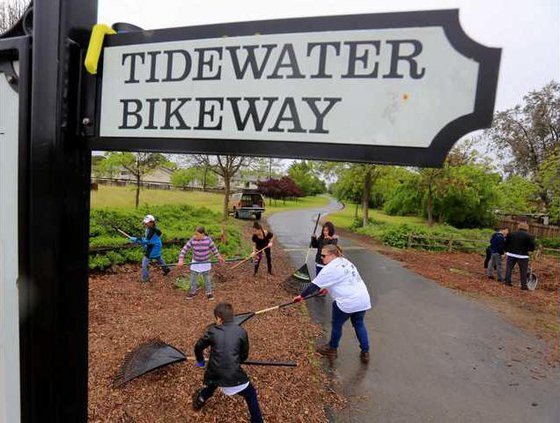
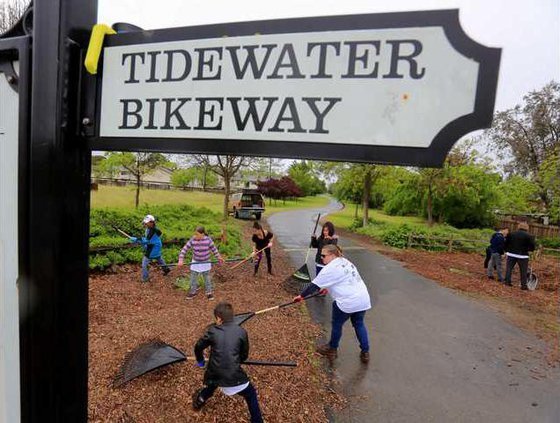
The 3.7-mile Tidewater Bikeway along abandoned railroad right-of-way is basically a linear city park stretching from Lathrop Road to Industrial Park Drive.
But it’s not a city park in the traditional definition.
It’s a cross between a park left in its natural state and one with a bit of landscaping.
The approach is driven by financial reality as well as an expensive trial and error period almost 30 years ago when the city tried to treat parts of it as if it were a quasi-neighborhood park.
At 35 acres, it is the city’s second largest park eclipsed only by the 52-acre Woodward Community Park.
The stretch of the Tidewater heading north past the skatepark is where the city maintains grass.
It is cut less frequently than in typical parks.
The Tidewater per se as it heads east from the skate park is barren dirt except for trees between the railroad tracks and the bike path.
There are city parcels along the Tidewater with a higher level of upkeep but that they are part of Library Park, the Manteca Transit Center, the arsenic removal treatment plant, a storm retention basin, and the Manteca Veterans Center.
It is true most older neighborhood parks aren’t as well kept as newer ones.
That’s because homeowners in newer neighborhoods pay annual assessments to pay for park upkeep and maintenance that often costs as much as $500 a year per home depending how many homes there are in a subdivision to spread out the cost.
That is in addition to property taxes.
Homeowners near older parks don’t pay such park upkeep assessments.
Instead, older parks are maintained with general fund revenue in competition with police, fire, street upkeep, and other day-to-day municipal functions.
There are “general fund” parks that get more attention. They are community parks such as Woodward, Northgate, Library, and Marion Ellitott as well as neighborhood parks that see extensive use by sports groups.
It should be noted the park fees collected within subdivisions cover 100 percent of the upkeep of the neighborhood park that can be used by anyone as long as they follow the rules.
To contact Dennis Wyatt, email dwyatt@mantecabulletin.com