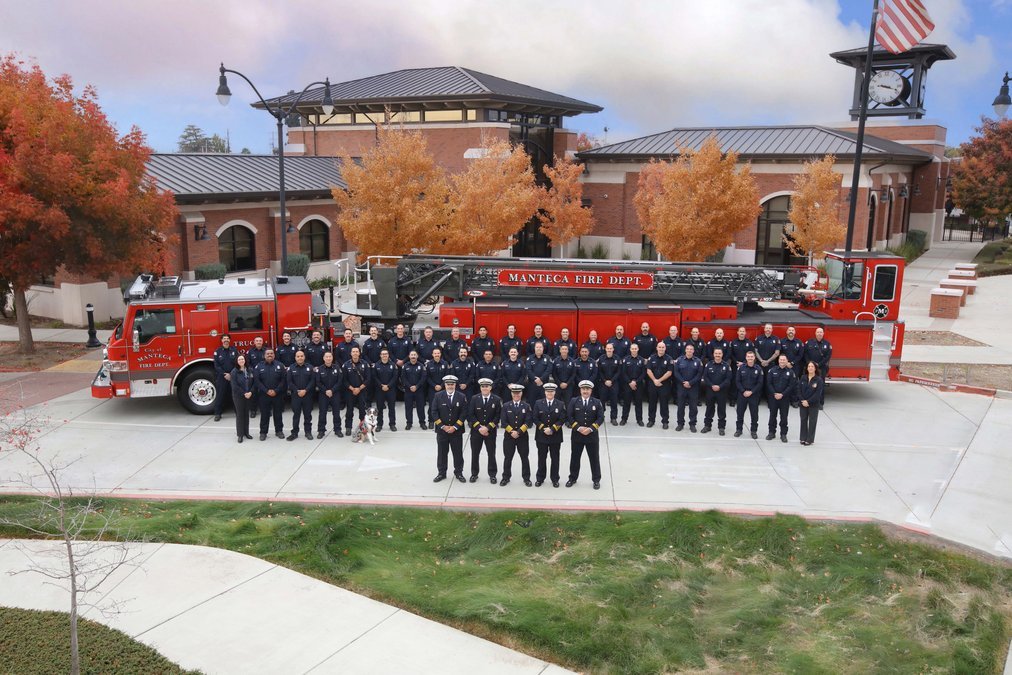
In Saturday’s Fourth of July parade in downtown Manteca, you will see a series of fire engines bringing up the rear.
It will include Manteca Fire Department’s oldest engine — a 1927 American LaFrance —and a newer engine such as the pair of 2025 Type 1 Smeal engines that joined the fleet earlier this year.
When you see them, ask yourself this question: Which one would you want to respond if your house was on fire?
It’s a no brainer. You’d want the modern engine complete with the latest technology.
And on that engine you’d want firefighters trained to handle various emergencies situations.
It’s why you call 9-1-1.
It is why you pay taxes.
Now what if you or a loved one is suffering a life threatening event such as a cardiac event or a stroke?
Given the majority of calls Manteca Fire responds to are medical emergencies the odds are more likely you’ll need a firefighter for a heart attack or stroke instead of a house fire.
It is why Manteca needs to have firefighters among its ranks that are more than just emergency medical technicians.
Paramedic certification allows a firefighter to perform advanced lifesaving care in the field prior to patient’s transport to the hospital.
Lathrop Manteca Fire District has had firefighters with advanced lifesaving training since January of 2025.
The fire district does not transport patients. They work in tandem with Manteca District Ambulance just like the City of Manteca Fire Department.
There are lot of big ticket items Manteca Fire needs to further step up its game and replace aging facilities and equipment.
One of those, a $12 million fire station in southwest Manteca is moving toward ground breaking.
The city — thanks to Measure Q and established of a major equipment replacement fund — is poised to finally get on a reasonable 10 year or so schedule to replace frontline engines. That is the point when engines rack up high mileage as well as wear and tear that start making them problematic in terms of reliability concerns.
The department this year added a sixth, 9 personnel fire company. Measure Q is helping make that possible.
There are at least four other big ticket items on the horizon.
*Replacing the Louise Avenue fire station with a new station on North Main Street.
*Adding a seventh fire company to keep the aerial truck manned as 24/7 as a specialty rescue and fire engine once the sixth station is opened and that sixth fire company is switched there.
*Eventually building and manning a seventh fire station east of Highway 99 as dictated by existing needs and growth.
*Building an in-city fire training facility so crews do not have to train outside of Manteca to allow for maximum coverage.
All of this costs money.
The City Council has been careful to note Measure Q is not a panacea as they work diligently on economic development and other measures to increase revenue flow to the general fund.
There are still more needs— as well as wants — that exceed what funding the city currently has.
One of the goals of the city is to establish a dedicated aerial/ladder company given the replacement cost of such trucks has soared past the $2 million mark.
That will involve nine more fire personnel reflecting a reoccurring full loaded with benefits and workmen’s compensation at a cost of roughly $1.2 million a year.
And while it is admirable the council is seeking to stretch the front-line life of the aerial truck, it should not be a higher priority than adding advance lifesaving skills among the ranks of firefighters.
Respond time is critical.
Adequate manpower is critical.
Engines and equipment that are reliable is critical.
But so is making sure those in life threatening medical situations such as cardiac events or stokes have the best reasonable initial care.
And you can make a solid case that the better investment of limited tax dollars is to have firefighters with advanced life training than stretching the useful life of a $2.1 million ladder truck.
Advanced lifesaving qualified personnel can provide advanced airway management, IV access, medication administration, and advanced cardiac care.
The training process is not cheap.
It involves more than 1,000 hours of didactic training, skills lab, hospital clinical training, field interning on an ambulance crew, and evaluation.
Time is money whether it is paying firefighters while they are training and/or engine company staffing replacement if needed.
Clearly, a paramedic position is better compensated. Not to do so would make the Manteca Fire Department a target for poaching.
A shift to advanced lifesaving clearly can’t happen overnight given it is a big ticket item.
That said, in the list of major needs for Manteca Fire in the coming years, it should take precedent in priorities over avoiding running an aerial/ladder truck as a front-line response fire engine.
In Saturday’s Fourth of July parade in downtown Manteca, you will see a series of fire engines bringing up the rear.