Future homebuyers in Manteca Trails will be the first to pay what amounts to supplemental annual taxes to make sure there is adequate funding for police and fire services.
At the same time, they will be paying an annual special tax to assure there is adequate city funds to maintain streets in their neighborhood.
The special taxes are part of Manteca’s Community Facilities Districts (CFD) of the future that will pay for maintenance not only of common landscaping and neighborhood park improvements as well as street lights but also public safety and street maintenance.
The City Council when they meet Tuesday at 7 p.m. at the Civic Center, 1001 W. Center St., is excepted to vote to put the mechanism in place that they directed staff to develop earlier this year. It would help assure new development covers the costs it creates for the municipal general fund.
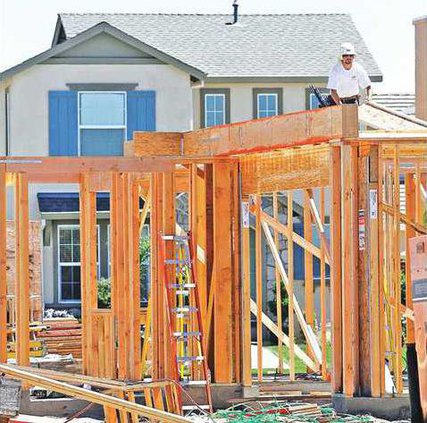
Manteca Trails is a 1,237-home project along the western end of Woodward Avenue south of the Oakwood Shores gated community.
The ordinance being adopted places the maximum annual assessment per house for parks and landscape upkeep at $599 and for street light maintenance including power costs at $69.
The exact tax per home for police and fire will be determined in the coming months.
Based on a preliminary study conducted earlier this year it could be as high as $1,152 annually.
The exact annual tax for police and fire will be determined by taking what each household will general in property taxes — the city gets roughly 17 percent of every dollar paid — and sales tax generated from residents and subtracting it against the per household cost of providing public safety.
The gap will be the special tax rate for public safety.
All of the annual assessments will have an adjustment for inflation.
Buyers of all new homes in Manteca in the future in projects that haven’t gotten beyond the point they can be encumbered with the stepped up CFD to pay for police and fire service as well as street maintenance will see an annual tax bill roughly 12 percent than other new homes in subdivisions that moved ahead before the city could implement the new fees
That’s based on a new home selling for $640,802.
Going forward, every time the house sells, roughly a $1,820 annual assessment would be transferred to the new owner along with any adjustments for inflation made on an annual basis.
When combined with other taxes, the bottom line of annual property assessments for that $604,802 house is $10,587.04.
That would also include:
*$6,408.02 in property taxes with the City of Manteca receiving roughly 17 percent and the rest being divided between Manteca Unified, San Joaquin County, South San Joaquin Irrigation District, Delta College and several other government agencies.
*$669.78 to retire Manteca Unified general obligation bonds.
*$104.06 to retire Delta College general obligation bonds.
*$1.86 for county mosquito abatement.
*$1,266 for Manteca Unified CFD for school facilities.
*$2.72 for San Joaquin Delta Water Zone 2.
*$4 for county hazardous waste disposal.
The total cost reflects only property assessments on new households. It doesn’t reflect the 8.25 percent sales tax they would pay on taxable goods in Manteca of which 1 percent goods to the city’s general fund, and ½ cent to the public safety measure tax that pays for 18 firefighters and 18 police officers.
The breakdown of the sales tax includes ½ cent to Measure K for road and transportation projects throughout the county with the remaining 5.25 cents going to the state.
The bottom line of $10,587 has struck some critics of the proposed police and fire service fee as being detrimental to the often stated policy goal of the City of Manteca’s to work toward more attainable housing for those who are in the workforce and have paychecks rooted in jobs in the Northern San Joaquin Valley and not west of the Altamont Pass.
The argument is unlike CFDs tied to new school facilities that end after 30 years, the CFD for police, fire and street upkeep — as well as existing CFDs for common subdivision landscaping, neighborhood parks, and neighborhood street lighting— will never go away. They are also adjusted annually for inflation.
At the same time those critical of Manteca’s failure to provide attainable housing are also critical of the city’s service levels for police and fire as well as ongoing street maintenance.
All three services are competing for general fund dollars that aren’t coming in robust enough to stay ahead of the city’s needs curve.
The push is for fees to augment police and fire services that aren’t generating enough money from new growth through property and sales taxes.
School district concerns
about police & fire CFD
Manteca Unified has formally notified the city of concerns they have that Manteca by adding the CFD for police and fire may be pushing the 2 percent cap the state imposes on such Mello-Roos districts.
What has been happening is developers have been utilizing the CFD mechanism with the city’s blessing to pay for the costs of sewer, water and other infrastructure for new subdivisions that they do not have to secure financing to cover. Such a 30-year encumbrance via the CFD mechanism is not reflected in the hypothetical example of a $604,000 new home’s annual property assessments that appears near the start of the article
The city has acknowledged the school district’s concern.
The NBS analysis projected by 2050 the city would have an annual shortfall of roughly $6.9 million needed to cover basic public safety and street maintenance from the general fund.
The fee if adopted, would apply to all new future homes that are encumbered by the CFD that are not deed restricted as being affordable housing.
Commercial areas would not be assessed as they generate more than enough city revenue to cover their impacts on both public safety and streets.
The proposed fees are based on a financial analysis of anticipated growth through 2050.
It assumes police and fire in Manteca currently provides services to 97,984 people. That figure includes 87,319 residents plus an adjusted employee population of 10,665 reflecting people who work in Manteca but do not reside here.
By 2050 the residential population is pegged at 131,361 along with 14,450 workers who have jobs in Manteca but do not reside here for a “persons served” population of 145,911.
Based on current service levels, Manteca in the year 2050 would be $6.9 million short annually.
To contact Dennis Wyatt, email dwyatt@mantecabulletin.com