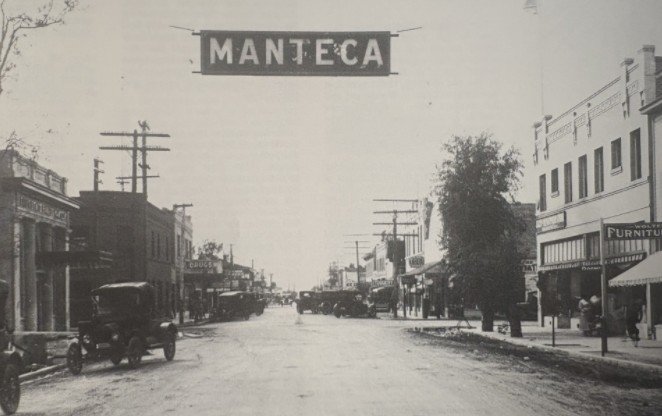
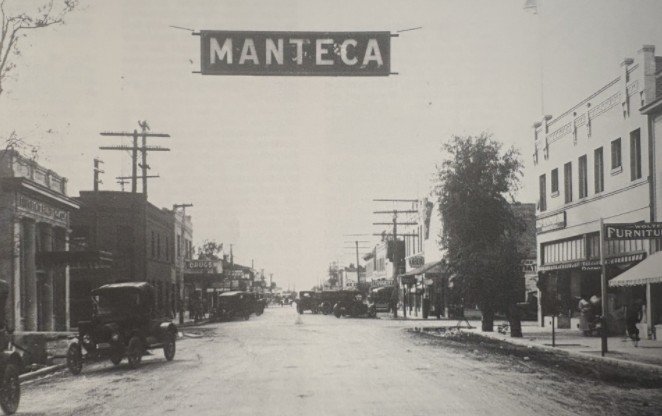
It’s been 109 years since Manteca civic leaders had a hankering to put the community’s name in lights above a main drag.
The year was 1917.
Manteca was on a roll.
South San Joaquin Irrigation District was working its magic.
Irrigation water was transforming Manteca and its surrounding countryside.
Depending upon accessibility to irrigation water, farmland was selling $80 to $130 an acre.
Advertisements boasted “no tract of land more than three miles from the railroad.”
There were 567 residents living in the Manteca town site and in close proximity based on a Christmas census in 1916.
Six months later, the population hit 1,250 as farmland was being snapped up.
That translates into a 130 percent annual growth rate.
Contrast that to Manteca’s 2025 annual 1.7 percent growth rate that took the city’s population to 93,733 as of Jan. 1, 2026.
In the coming few days, work will start on the installation on what is actually downtown Manteca’s first ever downtown street entrance arch.
The 1917 version was simply a metal box with the name of “Manteca” held in midair by wire stretched high above the street.
It was back when street lighting in downtown was a series of bulbs widely spaced strung across the street on a wire. They were turned off nightly before midnight.
The simple “Manteca” sign was hung near the midpoint of the 100 block of West Yosemite Avenue.
It was apropos given Manteca boosters at the time were celebrating the construction of what was then the $2 million Spreckels sugar beet processing plant plus 621 running feet of street frontage on Yosemite Avenue that was built in the first half of 1917.
Town boosters noted the commercial space “was all built in modern brick.” It nearly doubled the commercial space in Manteca.
Those 10 buildings cost $122,500.
Compare that to the 80-foot arch that will be going up across the 200 block of South Main Street next to the Manteca Animal Shelter that is costing $620,000.
The arch will be more than just the name “Manteca” hanging above the street.
For starters, it won’t be lit by incandescent bulbs.
It will use LED lighting with the ability to display a wide variety of colors.
And the supporting structure is more than mere wires.
It will include stylish support columns and a steel arch.
Some say the arch will help define downtown.
Others contend it will give Manteca residents a sense of being and instill community pride.
But at the end of day, the motivations were probably no different than what motivated the Board of Trade — a cross between a Chamber of Commerce and City Council — to put the community’s name up in lights to great travelers.
And Manteca, 109 years later is in the midst of a major commercial-retail expansion as the city is closing in on 100,000 residents.
As for those 10 buildings constructed in 1917, several are still standing today including the two-story Pezzoni & Wells Building that was built at a cost of $16,000 and now houses Tipton’s at West Yosemite and Maple avenues.
To contact Dennis Wyatt, email dwyatt@mantecabulletin.com