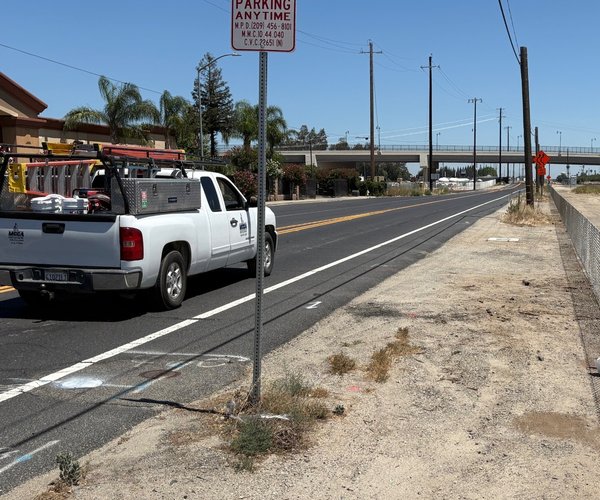

The 120 Bypass is a much more dangerous road to travel today than it was seven years ago.
California Highway Patrol statistics show that the number of traffic collisions has nearly doubled on the six-mile connector between Highway 99 and Interstate 5 since 2010.
It is part of the statistics in a letter sent by Manteca Mayor Steve DeBrum to regional elected leaders, Sacramento policy makers, area members of Congress, and key government agencies.
By year’s end the CHP anticipates 240 overall accidents with about a hundred of those crashes involving injuries. That reflects an accident every 1.5 days that is serious enough to require a CHP response. The bulk of the accidents — and where almost every death occurs — is in the eastbound lanes in the 1.5-mile stretch starting midway between the Union Road and Main Street interchanges and the Highway 99 transition ramps.
Back in 2010 an accident requiring CHP response happened every 2.8 days on the 120 Bypass.
Over a seven year stretch the CHP said 1,261 collisions have happened on the 120 Bypass resulting in 815 injuries and 11 deaths.
To emphasize the regional importance of the 120 Bypass and the need for safety improvements the mayor’s letter cites a 2014 University of Pacific Eberhardt School of Business Forecasting Center report that notes the largest inter-regional commute for Merced County (6,435 residents) and for Stanislaus County (17,550 residents) was to the greater Bay Area. The vast majority of those commuters pass through the 120 Bypass/Highway 99 interchange. The lion’s share of fatalities and injuries are victims with hometowns from the two counties to the south.
The letter is the latest in the Manteca City Council’s efforts to help push for a permanent solution in addition to short-term improvements Caltrans is undertaking. Design work has started on possible alternatives but funding has yet to be secured.
Most of the accidents are the result of traffic slowdowns nearing Highway 99. What happens typically are drivers will cut over into the right lane at the last possible second forcing cars and trucks already going slower in the right hand lane to hit their brakes. That triggers a chain reaction of brake lights and sets the stage for a Slinky-style traffic pattern.
Caltrans is moving forward with a series of short-term projects to try and improve safety. The first that is moving forward is the installation of an additional electronic warning sign between Union Road and Airport Way on eastbound 120 Bypass that is tied into four traffic monitoring installations using cameras to give motorists real time updates on slowing and backed up traffic. The project is costing $578,000.
The ultimate project DeBrum is pushing for is an additional transition lane from the 120 Bypass to southbound Highway 99.
That, however, is not as straight-forward as it may seem. The Austin Road interchange with its overpass built in 1955 poses a major roadblock.
Not only are there off and on ramps in close proximity to the 120 Bypass/99 interchange, but the Austin Road bridge makes it impossible to squeeze in another transition lane with a reasonable merging distance.
There are two alternates being considered for the long-term improvement.
The first could cost as much as $40 million. It would widen the connector to southbound 99 to two lanes, construct braided ramps (that are physically separated from freeway lanes) at the Austin Road interchange and replace the Austin Road crossing to provide an additional southbound 99 through lane. In some instances braided ramps require constructing bridge structures to send traffic above other lanes.
The second would cost upwards of $29 million to widen the connector to two lanes, permanently close Austin Road on and off ramps and replace the Austin Road overcrossing to provide an additional southbound 99 through lane.
The long-term project is proposed for funding with help from Measure K sales tax and savings from the Proposition 1B projects for Highway 99 improvements through the Central Valley as well as federal money.
DeBrum noted the goal the San Joaquin Council of Governments and Caltrans has put in place to tentatively start work in the summer of 2021 is fairly aggressive considering what has to be done.
Carnage doubles on Bypass