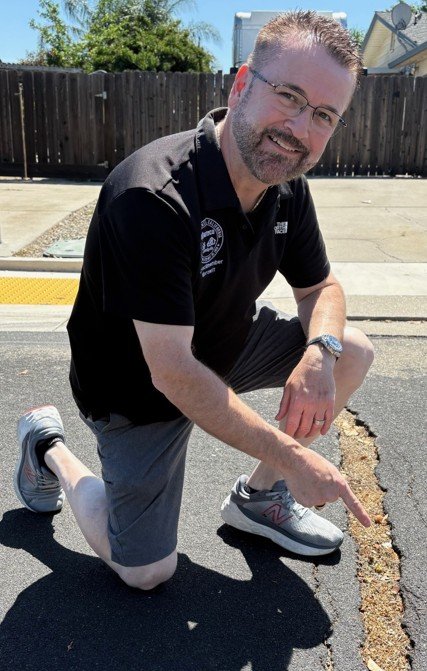
Mike Morowit is well aware of the “crack” epidemic plaguing the greater St. Francis Estates neighborhood in northwest Manteca.
The District 4 councilman has been working with city staff over the past four years to address more pressing hot spots in the area he represents as well as throughout the city.
A drive down Devonshire Avenue gives one an inkling of that effort.
There are more than two dozen instances of surgical patches where potholes have been moved and more problematic cracks fixed over the years.
The cost of long-term fixes on Devonshire Avenue is included in the more than $40 million of street work needs identified in the most recent pavement assessment study.
That study rated existing conditions on 265.4 lane miles of roadway the city maintains.
If stretched by one lane width, it would run from Manteca down Highway 99 to a point 17 miles south of Bakersfield after it merges with Interstate 5.
The study assessed what level of work was needed to replace pavement beyond repair and to extend the life of all existing pavement to avoid it from becoming a big ticket item to replace.
And even though Manteca has been knocking down the backlog at a relatively torrid pace of $5 million to $8 million annually in recent years between major arterials and neighborhood streets, the need keeps growing as all pavement ages and deteriorates as the years unfold.
Morowit ‘We’re working on it’
Morowit on Wednesday morning stood on Quincy Avenue south of Doxey Park where it T-intersects at Northgate Drive.
“We’re working on it,” Morowit said of efforts to get in place a massive neighborhood street fix as the city did in other 1960s-1970s era neighborhoods in the past five years such as Springtime Estates east of Main Street and north of Louise Avenue, Mayors Park in the triangle bounded by Louise Avenue, Union Road, and the railroad tracks as well as Shasta Park south of Louise and west of Cottage Avenue.
The crack issue was raised by a young homeowner on Quincy Avenue during public comments via Zoom at Tuesday’s City Council meeting.
The caller felt the city was ignoring his neighborhood in favor of more affluent and newer parts of Manteca when it came to street work.
Morowit was already aware of the problem but wanted to make sure there wasn’t a severe issue that warranted immediate attention.
The councilman noted going much beyond emergency repairs when a more holistic neighborhood project is being lined up — a strategy that has been repeated over the years in much older neighborhoods such as Powers Tract east of Manteca High — is problematic.
“It makes no sense as it would be throwing away money,” Morowit said.
That’s not a callous or flippant approach.
Doing work that would require outside contractors on a piecemeal basis instead of working on an overall neighborhood solution costs significantly more and ultimately reduces the amount of road work Manteca can tackle on an annual basis.
The same approach used has been used
in older, less affluent areas than St. Francis
It is the same approach the city has used over the years in much older and less affluent neighborhoods such as Powers Tract — built in the mid-1950s to early 1960s — to maintain streets until the city was in a financial position to do a more holistic project that also addresses sidewalk ADA issues and safety improvements.
The work in the St. Francis neighborhood, where current street conditions mirror what was in place at Mayors Park and Springtime Estates, will likely require extensive digging out and grinding of pavement just as what occurred in those two neighborhoods.
As such, it is likely not to come in under $1 million such as the seal coat and/or chip and seal work in the Del Webb and Union Ranch conducted recently in the two neighborhoods north of Lathrop Road.
Neighborhood-wide work such as needed in St. Francis Estates can easily be double to triple that amount.
Morowit notes the Del Webb work extended the pavement life to avoid it from developing St. Francis style problems.
As for the order neighborhood issues requiring an outside contractor gets addressed, it is determined by the staff pavement analysis with the council ultimately concurring when projects are put out to bid.
The amount of road work Manteca — and others cities have — reflects a simple fact.
Asphalt has a finite life.
On average, asphalt lasts 18 to 25 years.
To obtain that lifetime — and to extend it — routine seal coating is needed, cracks need to be sealed, chip and seal work needs to happen, and ultimately pavement overlays are needed.
The lifetime of asphalt is a crap shoot of sorts involving a number of factors: The existence or thickness of a base, traffic volume and weight loads, as well as climate.
Money is the big issue
& Measure Q is helping
The bottom line is it takes money to maintain and fix roads while also providing police, fire and other services. Public safety alone accounts for almost 68 cents of every dollar spent from the general fund to pay for day-to-day municipal services.
California cities do have a dedicated revenue stream — the local share of gas tax receipts that Sacramento determines what flows to local jurisdictions for street maintenance. The money funneled through the state has been declining in recent years.
The amount of gas tax revenue doled out on a per capita basis in Manteca’s proposed budget for the fiscal year starting July 1 is $2.7 million. Another $2.6 million comes from Senate Bill 1 tied onto the 2017 major readjustment of the gas tax that included adding an annual inflation adjustment that survived a statewide effort in 2018 to repeal it.
The gas tax revenue collected on each gallon of gasoline has been dropping due to electric vehicle sales and more fuel efficient gas-powered vehicles.
It is one of the reasons why Morowit, and the rest of the current council, put the 20-year Measure Q three-quarter of a cent sales tax on the November 2024 ballot.
The voter approved measure is contributing $2.5 million to citywide street work in the next fiscal year.
Even more important, it has put Manteca in a relatively unique position of having local matching funds to do road work to stretch.
Such is the case of $4.7 million in state funds the city was able to secure using an 11 percent local match from Measure Q to redo pavement in the coming fiscal year on Yosemite Avenue all the way from Walnut Avenue west to the city limits with Lathrop along the railroad tracks.
That money became available after other cities weren’t able to match the funds.
Measure Q is not only backfilling gas tax revenues that have been lost but it is allowing even more annual road work to be done.
Bringing work in house
Morowit said the city is also in a position to do small pieces of a larger project in multiple years to address the most egregious sections of pavements thanks to a decision three years ago to buy specialized road repair equipment that goes beyond being able to make temporary fixes on potholes and cracks on a piecemeal patchwork approach.
The highest profile example is Spreckels Avenue-Industrial Park Drive where four different segments with the worst pavement conditions have been remedied in house by the city street crew.
Other segments of Spreckels will be addressed in the next few years.
While it doesn’t address the entire street at the same time, it has allowed the city to take steps that are clearly more effective and lasting than patchwork repairs, which is all they were able to do for years.
Morowit notes city crews in the coming weeks will be doing alley work near the old Yosemite School (now the Manteca online school) on West Yosemite Avenue.
They will effectively allow crews to practice with recently acquired equipment before using it to aim et general street work.
Work in District 4
There has been in excess of $12 million of road work on District 4 during the past eight years.
That includes 2,700 feet of roadway on Lathrop Road completely rebuilt east of the intersection with Airport Way, Lathrop Road from Union Road to Highway 99, Louise Avenue from Main Street to Highway 99, sections of Airport Way from Louise Avenue to Roth Road, Main Street from Louise Avenue to Northgate Drive, Springtime Estates, Del Webb, and Union Ranch.
The work is in addition to new traffic signals on Lathrop Road west of Union Road, speed lumps, routine and emergency street maintenance, and other safety improvements.
To contact Dennis Wyatt, email dwyatt@mantecabulletin.com
.